 fidopt
PSMA-PET-CT-Lesions follow-up (Learn2Reg 2026 PSMAReg)
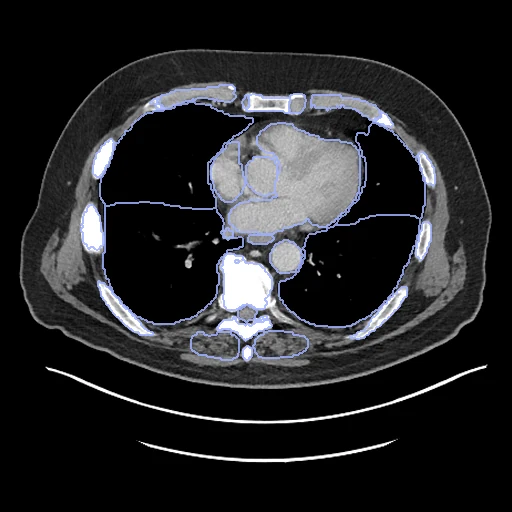
Whole-body CT of one man with prostate cancer at his first PSMA-PET/CT study (fixed) and his second, 98 to 171 days later (moving), PSMA-avid lesions drawn on each PET (PSMA-PET-CT-Lesions; Learn2Reg 2026 PSMAReg).
Read before comparing (11)
- Links. The truth is the centres of lesions drawn on each study's PET, linked one to one by prepare.py since the provider links none: two lesions link when their offsets from the centre of the TotalSegmentator structure holding them are mutual nearest neighbours within 10 mm, with no rival within twice their distance. No image and no alignment is used.
- Grading. People drew every lesion, but a program made the links and no person checked them all: the landmarks are graded automatic and the dataset is ranked apart. Checked by eye on every test pair, all links of three pairs and the eight to ten farthest apart on the others, each link joins one lesion at one place of one bone.
- Lesions. 233 of the 912 lesions on the smaller side of the ten test pairs are linked, 6 to 82 a pair (median 13), all in bone but one, mostly ribs (98) and vertebrae (54). Lymph nodes, lesions outside a structure or in a cut one, ambiguous neighbours, and lesions that appeared, vanished, merged or split stay unlinked.
- Floor. Under therapy the linked lesions changed volume by a median factor of 1.09, moving their centres within the bone, and PET voxels of 2.73 to 4.07 mm limit how well a centre is placed. Links under 30 mm apart move by vectors 2.1 mm apart at the median, an estimate of the floor; 3.7 mm within a vertebra's frame bounds it from above.
- Images. The pair is the two CTs; each PET's lesions reach its CT through the scanner's frame. Where breathing or the bladder moves the body between CT and PET, a lesion centre is off its CT by an unmeasured amount, least in bone.
- Alignment. The studies lie 35 to 1325 mm apart. The moving CT's header carries one rigid start from elastix mutual information inside each body, no lesion or label used: rigid because the patient lies otherwise at the second study, the starts turning the moving CT by 1.0 to 5.3 degrees.
- Baseline. With no registration the 10 test pairs score a lesion-centre error of 7.6 mm (4.6 to 15.7), 14.8 mm at the 95th percentile, two to four times the floor; label Dice 0.62 (0.50 to 0.72), HD95 10.2 mm; lesion Dice 0.31 (0.19 to 0.39).
- Shown, not ranked. TotalSegmentator's labels and the linked lesion masks: lesion volumes change under therapy, so their overlap rewards a field that shrinks or grows them. No lesion inside a defaced box is linked.
- Cohort. 597 studies of 378 men at LMU University Hospital Munich, defaced by TCIA. One reader drew every PSMA-avid lesion on the PET, validated by board-certified experts.
- Overlap. No patient of AutoPSMA, AutoPSMA_CTPET_Syn or PSMALesionsPET is here, by ID, and no patient is in two of the 20 cases.
- Outside numbers. None: Learn2Reg 2026 PSMAReg trains on these 597 studies, resampled, and scores labels, lesion volume and uptake, and folding on its own Johns Hopkins test pairs; it links no lesion.
| Accuracy | Smoothness | Cost | ||||||||||
|---|---|---|---|---|---|---|---|---|---|---|---|---|
| # | Method | TRE mm | Change | Dice * | HD95 mm * | rTRE | SDlogJ | Folds % | Time s | RAM GB | GPU GB | Images |
| 11–4 | deedsCPUapp | 5.13 ±0.98 | −2.45 | 0.844 ±0.028 | 5.82 ±2.26 | 0.0047 ±0.0009 | 0.088 | 0.03 | 262 | 13.8 | ||
| 11–4 | NiftyRegCPUapp | 5.39 ±1.05 | −2.20 | 0.823 ±0.039 | 6.91 ±2.97 | 0.0049 ±0.0010 | 0.075 | 0.08 | 308 | 6.7 | ||
| 31–4 | greedyCPUapp | 5.61 ±1.51 | −1.97 | 0.801 ±0.041 | 7.38 ±2.71 | 0.0051 ±0.0014 | 0.031 | 0.00 | 197 | 13.8 | ||
| 41–4 | ConvexAdam (MIND)GPUapp | 5.27 ±1.09 | −2.31 | 0.835 ±0.027 | 6.52 ±2.70 | 0.0048 ±0.0010 | 0.096 | 0.33 | 60 | 6.6 | 18.8 | |
| 41–4 | DemonsCPUapp | 5.50 ±1.16 | −2.08 | 0.805 ±0.050 | 6.96 ±2.80 | 0.0050 ±0.0011 | 0.082 | 0.30 | 59 | 9.8 | ||
| No registration | 7.58 ±2.23 | 0.622 ±0.061 | 10.22 ±3.05 | 0.0069 ±0.0021 | 0.000 | 0.00 | ||||||
The order averages each method's ranks on TRE mm, SDlogJ, so the first one is not always the best in every column. ± is the 95% interval of the mean over the 10 pairs. Two neighbours are tied when a paired Wilcoxon test on the shared pairs does not find the upper one better on TRE mm (5%): the places a method could hold are then shown under its own. The best value of each column is in colour. Click a row to see its images, a column title to sort by it. Time and memory measured on Laptop.
* shown, not ranked: on this dataset it is checked against the output of a program.
Dice: how much the organ contours overlap, 1 is perfect. HD95: distance between the contours' surfaces. TRE: distance between matching landmarks. rTRE: the TRE over the length of the image's diagonal, to compare datasets of other sizes and units. SDlogJ: how irregular the deformation is, 0 is perfectly smooth. Folds: share of the image where the deformation folds over itself.
Pair by pair
Click a score to look at that result: the fixed image, and over it the moving image after registration, with the annotations. Underlined scores have their image; for the others you see the pair without the result. A green cell gained against no registration on that pair, a red one lost.
About the data
- Test pairs
- 10 test pairs drawn with seed 2026 by the first study's scanner (7, 2 and 1) among the 67 outside development, then 10 development pairs, the last of the same seeded order, the scanners in proportion too (6, 3 and 1). The pool is the 80 patients outside AutoPSMA whose first two studies both hold at least ten lesions, less three whose lesions the rule could not link.
- Truth
- landmarks by a program contours by a program lesion by a program TotalSegmentator (task total) run by us on each CT, in overlapping parts along the body, as for LongitudinalCT the centres of the lesions drawn on the PET of each study, for the lesions linked one to one between the two studies by the bone they lie in (prepare.py), all in bone but one: 6 to 82 a pair, 233 in the ten test pairs
- Source
- www.cancerimagingarchive.net/collection/psma-pet-ct-lesions
doi.org/10.7937/r7ep-3x37
www.cancerimagingarchive.net/wp-content/uploads/PSMA-PET-CT-Lesions-CLINICAL_v01_20251118.tsv
wiki.cancerimagingarchive.net/display/Public/TCIA+De-identification+and+Curation+-+Public
learn2reg.grand-challenge.org
github.com/JHU-MedImage-Reg/Learn2Reg26_PSMA - Licence
- CC BY 4.0
10 pairs for tuning, never tested
PSMA_fd142797eb926383, PSMA_2fe466a567a7eab3, PSMA_751d8b9d08e7859c, PSMA_348a4dbda705c573, PSMA_6f538887f996bfaf, PSMA_83df8050261c44fd, PSMA_ffa9445e55e2b071, PSMA_80d66794f885f503, PSMA_d221fa198555e92e, PSMA_bc63defabeea583e