 fidopt
VerSe
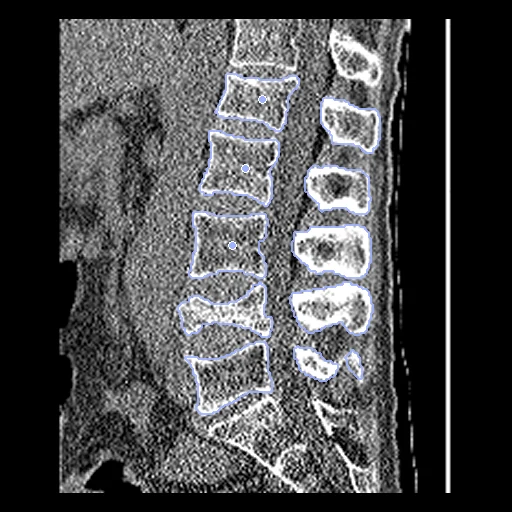
Spine CT of two patients, from the cervical spine alone to the whole spine depending on the scan, paired by us from VerSe 2019 and 2020, with each vertebra labelled on both.
Read before comparing (10)
- Pairs. The patients of a release are paired two by two in the order of sha256("2026:VerSe:<subject>"), and a pair enters when both scans hold at least five vertebrae whole in common: 113 of the 168 pairs do (33 of 61 in VerSe 2019, 80 of 107 in VerSe 2020).
- Held out. Drawn and replaced: sub-verse563_sub-verse503 and sub-verse644_sub-verse546, a whole spine against 6 or 7 vertebrae, and sub-verse500_sub-verse754, its lumbar segment three levels off. No start from the intensities places a short segment on a whole spine of repeating vertebrae. 18 VerSe 2019 patients with two or three series (sub-verse400 to sub-verse417) stay out.
- Labels. A network's vertebra masks, corrected by hand by trained medical students, reviewed by radiologists and approved by one radiologist with 19 years in spine imaging; VerSe 2020's paper puts the correction at about 1 mm. No second rater. Every vertebra both scans hold is scored, cut ones included: one the moving scan cuts cannot reach a Dice of 1.
- Landmarks. The dataset's centroids of the vertebral bodies, placed by a network and corrected where needed; the authors note that centroids vary much within and between raters. One point a vertebra says nothing of its rotation or of the tissue around the spine. Vertebrae that either field of view cuts are left out.
- Variants. Vertebrae are matched by name (C1 to L6, and T13). Half of VerSe 2020's 300 subjects were chosen for anatomical variants, such as transitional vertebrae, 4 or 6 lumbar vertebrae or cervical ribs, so one name may sit at different levels in the two spines. The sacrum and vertebrae fused with it are not labelled.
- Alignment. The two scans have unrelated origins and keep their native voxels and grids. With the images' centres together the vertebrae do not meet (Dice 0.00 on 9 of the 11 test pairs), so the start is an elastix translation on mutual information inside each body, no label or landmark used, written in the moving image's, labels' and landmarks' headers.
- Baseline. With no registration the 11 test pairs score a landmark error of 24.5 mm (14.3 to 38.5) and a vertebra Dice of 0.19 (0.00 to 0.36). On sub-verse711_sub-verse576 and sub-verse768_sub-verse557 the pelvis lies on the pelvis, yet the labels sit about one level apart (Dice under 0.01, 33 to 39 mm): a transitional vertebra changes the numbering.
- Pathology. Traumatic fractures and bony metastases were left out of both releases. Vertebral fractures, degenerative changes and kyphoplasty or spondylodesis material are in: a vertebra may change shape between the two spines, and metal may sit in one scan only.
- Grids. The authors resampled the VerSe 2019 scans to about 1 mm; VerSe 2020's new scans keep their own resolution, down to 0.2 mm in plane. The field is asked on the fixed grid, up to 583 x 512 x 1626 voxels on the test pairs. Some scans fill the space outside the reconstructed field of view with -2048 instead of -1024.
- Outside numbers. None: the pairing is ours.
No method has a result on every pair of this dataset yet.
| Accuracy | Smoothness | Cost | ||||||||||
|---|---|---|---|---|---|---|---|---|---|---|---|---|
| # | Method | Dice | Change | HD95 mm | TRE mm | rTRE | SDlogJ | Folds % | Time s | RAM GB | GPU GB | Images |
| No registration | 0.191 ±0.081 | 23.95 ±5.80 | 24.48 ±5.78 | 0.0367 ±0.0152 | 0.000 | 0.00 | ||||||
1 result not ranked: an older run, pairs still missing, or a failure on every pair
| Accuracy | Smoothness | Cost | |||||||||||
|---|---|---|---|---|---|---|---|---|---|---|---|---|---|
| # | Method | Dice | Change | HD95 mm | TRE mm | rTRE | SDlogJ | Folds % | Time s | RAM GB | GPU GB | Machine | Images |
| ConvexAdam (MIND)GPUapp6/11 pairs | 0.406 ±0.276 | +0.215 | 20.50 ±10.60 | 16.59 ±10.50 | 0.0288 ±0.0198 | 0.131 | 1.85 | 21 | 4.1 | 9.1 | Laptop | ||
Dice: how much the organ contours overlap, 1 is perfect. HD95: distance between the contours' surfaces. TRE: distance between matching landmarks. rTRE: the TRE over the length of the image's diagonal, to compare datasets of other sizes and units. SDlogJ: how irregular the deformation is, 0 is perfectly smooth. Folds: share of the image where the deformation folds over itself.
Pair by pair
Click a score to look at that result: the fixed image, and over it the moving image after registration, with the annotations. Underlined scores have their image; for the others you see the pair without the result. A green cell gained against no registration on that pair, a red one lost.
About the data
- Test pairs
- 11 test pairs and 10 development pairs drawn with seed 2026 from the 113 eligible pairs, stratified by release; each patient is in one pair only. Three drawn test pairs whose scans cover different segments were replaced by the next pairs of the seeded order whose scans share at least 70% of their vertebrae.
- Truth
- contours by experts landmarks by a program, verified by people the dataset's vertebra masks, one label a vertebra, corrected by hand and approved by radiologists the dataset's centroids of the vertebral bodies that both scans hold whole, 5 to 15 a test pair
- Source
- github.com/anjany/verse
osf.io/nqjyw
osf.io/t98fz
doi.org/10.1016/j.media.2021.102166
doi.org/10.1148/ryai.2020190138
doi.org/10.1038/s41597-021-01060-0 - Licence
- CC BY-SA 4.0
10 pairs for tuning, never tested
sub-verse145_sub-verse095, sub-verse505_sub-verse642, sub-verse716_sub-verse565, sub-verse591_sub-verse529, sub-verse600_sub-verse821, sub-verse596_sub-verse558, sub-gl047_sub-verse587, sub-gl016_sub-verse549, sub-verse762_sub-verse752, sub-verse599_sub-verse833