 fidopt
Tongue musculature MRI
3D MR of the mouth of two healthy adults of one study, T2-weighted (BeLong, EATT4MND) or T1-weighted (BMC), with labels of the tongue muscles (Ribeiro et al. 2025), paired by us.
Read before comparing (9)
- Cohort. 47 healthy adults (20 women, 25 to 80 years), controls of three Australian studies of motor neuron disease, one 3D scan each: 4 BeLong, 3D SPACE T2-weighted at 0.8 mm; 19 EATT4MND, 3D SPACE T2-weighted at 1 mm; 24 BMC, coronal MPRAGE T1-weighted at 1 mm. BMC's sub-139 (development pair BMC_001_139) comes on a 0.8 mm grid.
- Pairs. A pair joins two participants of one study, so its scans share scanner and contrast. A study's participants are put in the order of sha256("2026:TongueMR:<image name>") and paired two by two: 2 BeLong, 9 EATT4MND (sub-015 left out) and 12 BMC pairs. The pairing is ours: no outside number compares.
- Truth. One author drew three BeLong tongues by hand; on the other scans a network or ANTs joint label fusion proposed the labels, which the authors corrected by hand where needed. Ribeiro and Shaw last inspected, corrected and smoothed every map (1 mm Gaussian). No agreement between raters is given.
- Labels. Four labels: the transverse and vertical muscles as one, the superior longitudinal, the inferior longitudinal and the genioglossus. The other muscles entering the tongue from outside and everything around it are not labelled: the board measures the tongue alone. On the 40 participants built the labels hold from 17.7 to 37.0 cm³ (transverse and vertical) down to 3.5 to 8.5 cm³ (inferior longitudinal).
- Images. Each scan keeps its acquisition grid and oblique frame, set to zero outside a box around the mouth for anonymity; every label lies inside it. On EATT4MND sub-064 (test pair EATT4MND_001_064) the field ends at the lowest tip of the transverse and vertical label. Values are 32-bit floats with no unit and no common scale; no mask is given.
- Alignment. The moving headers carry one elastix translation on mutual information inside each head, found on what the box holds, no label used; no voxel is resampled. A rigid start would turn the heads 1.5 to 15 degrees on the test pairs: that pitch is left to the methods.
- Baseline. With no registration the test pairs score a Dice of 0.50 (0.36 to 0.71) and an HD95 of 9.1 mm (4.0 to 13.7).
- Seen. The release's study templates and joint label fusion atlas are not used: built from these participants and BMC's labels, they would let a method see the test participants.
- Overlap. No other dataset of the corpus holds these participants. The files were read on 2026-10-11, after the release of 2026-09-08 corrected BMC sub-078's labels (development pair BMC_078_015).
| Accuracy | Smoothness | Cost | ||||||||
|---|---|---|---|---|---|---|---|---|---|---|
| # | Method | Dice | Change | HD95 mm | SDlogJ | Folds % | Time s | RAM GB | GPU GB | Images |
| 1 | ConvexAdam (MIND)GPUapp | 0.707 ±0.046 | +0.209 | 6.23 ±2.24 | 0.030 | 0.01 | 8 | 2.7 | 3.3 | |
| 22–4 | DemonsCPUapp | 0.553 ±0.095 | +0.055 | 7.77 ±2.35 | 0.021 | 0.00 | 10 | 1.7 | ||
| 22–4 | greedyCPUapp | 0.660 ±0.066 | +0.162 | 6.41 ±2.06 | 0.043 | 0.00 | 34 | 2.4 | ||
| 42–4 | NiftyRegCPUapp | 0.607 ±0.099 | +0.109 | 9.02 ±3.30 | 0.034 | 0.06 | 44 | 1.2 | ||
| No registration | 0.498 ±0.094 | 9.09 ±2.46 | 0.000 | 0.00 | ||||||
The order averages each method's ranks on Dice, HD95 mm, SDlogJ, so the first one is not always the best in every column. ± is the 95% interval of the mean over the 10 pairs. Two neighbours are tied when a paired Wilcoxon test on the shared pairs does not find the upper one better on Dice (5%): the places a method could hold are then shown under its own. The best value of each column is in colour. Click a row to see its images, a column title to sort by it. Time and memory measured on Laptop.
Dice: how much the organ contours overlap, 1 is perfect. HD95: distance between the contours' surfaces. SDlogJ: how irregular the deformation is, 0 is perfectly smooth. Folds: share of the image where the deformation folds over itself.
Pair by pair
Click a score to look at that result: the fixed image, and over it the moving image after registration, with the annotations. Underlined scores have their image; for the others you see the pair without the result. A green cell gained against no registration on that pair, a red one lost.
About the data
- Test pairs
- 10 test pairs drawn with seed 2026 among the 23, by study: 5 BMC, 4 EATT4MND and 1 BeLong. The 10 development pairs are 4 EATT4MND and 6 BMC; BeLong_013_011, EATT4MND_046_040 and BMC_130_027 are in neither.
- Truth
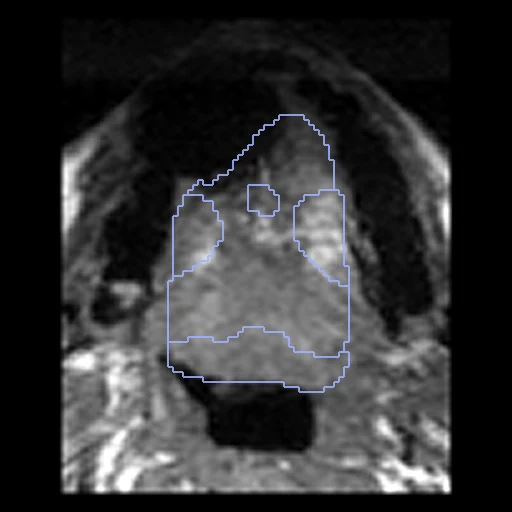
- contours by experts the dataset's labels of the tongue muscles: 1 the transverse and vertical muscles (one label), 2 the superior longitudinal, 3 the inferior longitudinal, 4 the genioglossus; proposed by a network or an atlas fusion, then checked and corrected by hand by two of the authors
- Source
- osf.io/wt9fc
doi.org/10.17605/OSF.IO/WT9FC
doi.org/10.1038/s41597-025-05092-8
github.com/thomshaw92/TongueSegMND
doi.org/10.1016/j.compbiomed.2025.110824 - Licence
- CC0 1.0
10 pairs for tuning, never tested
BMC_035_081, BMC_098_099, EATT4MND_025_049, BMC_001_139, EATT4MND_063_039, BMC_078_015, EATT4MND_026_062, BMC_140_000, EATT4MND_061_008, BMC_107_090