 fidopt
QIN-BREAST, prone CT to PET
Low-dose CT (source) and FDG-PET in SUV (target) of the chest of a woman with breast cancer lying prone, from one PET/CT session before or during neoadjuvant chemotherapy, the CT on the PET's grid (QIN-BREAST).
10 test casesbreastsource CT, target PET
Read before comparing (10)
- Alignment. One prone session on one GE Discovery STE at Vanderbilt University: the low-dose CT, then the PET 1.2 to 4.8 minutes after its first slice, on one table and in one frame of reference. As in AutoPET_CTPET_Syn, prepare.py brings the CT onto the PET's grid of 5.47 mm voxels by a cubic spline, rounded to whole Hounsfield units; nothing is registered.
- Prone. The breasts hang in a support built in-house: anatomy and protocol are what this dataset adds to AutoPET_CTPET_Syn's supine whole bodies. The files keep the scanner's prone patient axes, as the direction matrix says. The patients' MR is not used.
- Target. Attenuation-corrected PET in body-weight SUV, the dose decayed to the start of the series, with AutoPET_CTPET_Syn's function. The weight, dose and injection time come from the PET's header and were checked against nothing else.
- Source. The low-dose CT without contrast agent, its padding set to air. On the PET's grid one CT voxel in four is kept in the plane, with no smoothing: the source keeps the CT's noise and no detail finer than 5.5 mm. The support and table lie in the source, outside the mask.
- Motion and uptake. The PET averages 2 minutes a bed position of free breathing: near the diaphragm and heart a perfect synthesis is still scored off, alike for every method. Myocardial uptake varies, the tumours take up the tracer, and the hottest voxels, up to 60 SUV on a test case, lie in the lowest slices on most cases past 20 SUV.
- Mask. The body where both images hold it: the CT above -500 HU with the air it encloses in the body (lungs, airways), opened by one voxel to detach the support and table, its largest component, holes filled slice by slice, minus the voxels where the PET reads exactly 0. The target is scored in it, and methods are given it.
- Range. truth.dynamic_range is 20, as in AutoPET_CTPET_Syn, so the track reads one SUV scale: 0 to 20 holds 99.95 to 100% of each test mask's voxels. Voxels past 20 still count, with their whole error.
- Baseline. On the test cases a constant at the target's median inside the mask scores, as the mean over the cases and its range, an MAE of 0.39 (0.31 to 0.53) SUV, a PSNR of 28.5 (22.4 to 32.3) dB and an SSIM of 0.78 (0.73 to 0.82). The source, in Hounsfield units, is not scored against the target.
- Time point. A case is a patient's first prone study by date; whether it falls before treatment, after its first cycle or later was not checked against the collection's treatment-response sheet.
- Overlap. No other dataset of the corpus holds QIN-BREAST images. These test and development patients keep their partition in any later dataset of this collection, and their later studies stay out of this one.
No method has a result on every case of this dataset yet.
Case by case
Click a score to look at that result: the target image, and over it the method's synthetic image. Underlined scores have their image; for the others you see the case without the result.
About the data
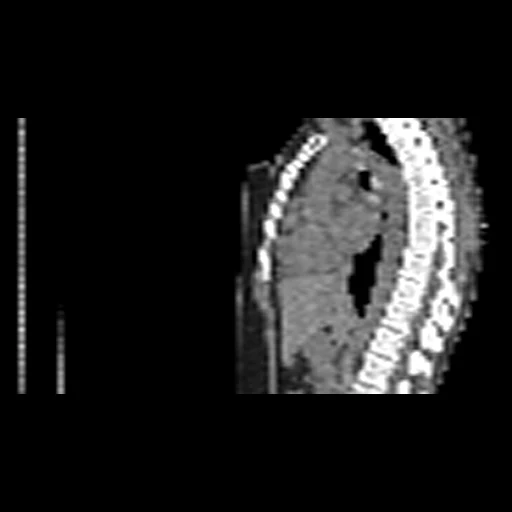
The first test caseClick to look at every case.
- Test cases
- 10 test patients drawn with seed 2026 among the 33 outside development, then 10 development patients, the last of the same seeded order. The pool is the 43 patients with a prone PET/CT study, each patient's first one, drawn without strata: one scanner, one protocol.
- Truth
- target image as released the FDG-PET of the same prone session, attenuation-corrected, in body-weight SUV, on its own grid, which the CT is brought onto through the scanner's frame of reference
- Source
- www.cancerimagingarchive.net/collection/qin-breast
doi.org/10.7937/K9/TCIA.2016.21JUEBH0
services.cancerimagingarchive.net/nbia-api/services/v1/getSeries?Collection=QIN-BREAST
doi.org/10.1097/RLI.0000000000000100 - Licence
- CC BY 3.0
10 cases for tuning, never tested
QIN-BREAST-01-0061, QIN-BREAST-01-0033, QIN-BREAST-01-0017, QIN-BREAST-01-0006, QIN-BREAST-01-0005, QIN-BREAST-01-0001, QIN-BREAST-01-0034, QIN-BREAST-01-0022, QIN-BREAST-01-0020, QIN-BREAST-01-0035