 fidopt
BraTS 2021 adult glioma
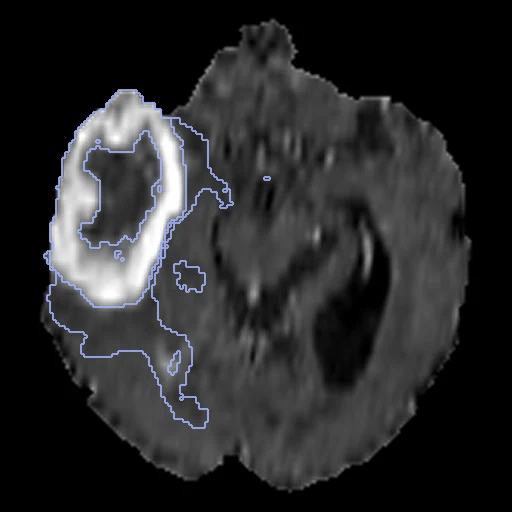
Pre-treatment brain MR of an adult with a glioma, T1, T1Gd, T2 and FLAIR as one four-channel image, with the necrotic core, oedema and enhancing tumour labelled (RSNA-ASNR-MICCAI BraTS 2021 training set, TCIA).
Read before comparing (11)
- Pool. 1,251 adults with a glioma, one pre-operative examination each, from 24 sites on varied protocols and scanners. The challenge's validation and test cases have no public label map. The 30 test subjects are twelve from UPenn, nine from UCSF and one each from nine other sites.
- Images. One image of four channels a voxel, T1, T1Gd, T2, FLAIR, as the annotators read them; a method that takes one value a voxel picks its channel in its adapter. The provider registered the sequences to the SRI24 atlas, resampled them to 1 mm and skull-stripped them: 240 x 240 x 155 voxels on every case. No mask is given.
- Values. Each scanner's units, untouched, on scales that differ between sites: the T1Gd's median in the brain is 220 to 2,980 on the first ten test cases. Sequences acquired in thick slices stay blurred once resampled, as the T1 of test case 01502.
- Truth. The STAPLE fusion of three networks trained on BraTS 2020, refined in ITK-SNAP by volunteer neuroradiology experts on the four sequences; two senior neuroradiologists reviewed every map and returned it until they accepted it. One map a subject, no second reader and no agreement measure: graded semi-automatic.
- Labels. 1 is the necrotic core, 2 the oedema and infiltrated tissue around the tumour, 4 the enhancing tumour, values as delivered. Each label is scored on its own, not as BraTS's nested regions, so the numbers do not compare with the challenge's. A label a case lacks scores only if a method writes it, a false positive at 0.
- Tumours. Every one of the 1,251 maps holds a tumour, 1,180 all three labels. The thirty test tumours hold 7.1 to 261 ml. Test case 01502 (TCGA-LGG) has no enhancing tumour.
- Checks. On the cases built first each channel equals its file in the package, and the enhancing tumour lies on the T1Gd's rim, the necrosis inside it and the oedema on the FLAIR's hyperintensity.
- Room. The test labels moved by one voxel keep a Dice of 0.83 for the necrosis, 0.87 for the oedema and 0.88 for the enhancing tumour, means of six moves; the surface Dice is at 1 mm, BraTS setting no tolerance. Isensee et al. 2024 find BraTS 2021's scores saturated, with minimal variation between methods.
- Exposure. The training set's label maps are public: a network trained on BraTS data may have seen these subjects.
- Overlap. Patients of UPENN-GBM, UCSF-PDGM, TCGA-GBM, TCGA-LGG, IvyGAP and CPTAC-GBM are inside this release (TCIA's crosswalk): a dataset built later from those collections leaves these patients out. BraTS2021_Syn shares none of these 60 subjects: its pool leaves out those first drawn, and the later development subjects were drawn outside its cases.
- BraTSReg. BraTSReg_098, 108, 117, 121 and 122 have a BraTS 2021 T1Gd as moving image, byte for byte: those five subjects are left out. Every subject drawn was compared with BraTSReg's images: none is a BraTSReg patient (correlation at most 0.47). No other dataset of the corpus holds brain MR of these collections.
No method has a result on every case of this dataset yet.
Case by case
Click a score to look at that result: the image, the truth in green and the method's map in red. Underlined scores have their image; for the others you see the case without the result.
About the data
- Test cases
- 30 test subjects drawn with seed 2026 by contributing site, in proportion, among the 1,216 training subjects outside development, then 30 development subjects, the last of the same seeded order, the sites in proportion: 13 UPenn, 10 UCSF and one each from seven others, none a subject of BraTS2021_Syn. The pool is the 1,251 subjects with a label map, less five whose T1Gd is a BraTSReg moving image byte for byte (BraTS2021_00020, 00469, 00511, 00543 and 00580).
- Truth
- contours by a program, verified by people the dataset's three labels, 1 the necrotic tumour core, 2 the peritumoral oedematous and infiltrated tissue, 4 the enhancing tumour: the STAPLE fusion of three networks trained on BraTS 2020, refined by volunteer neuroradiology experts in ITK-SNAP on the four sequences, every map reviewed and approved by two senior board-certified neuroradiologists
- Source
- www.cancerimagingarchive.net/analysis-result/rsna-asnr-miccai-brats-2021
doi.org/10.7937/jc8x-9874
doi.org/10.48550/arXiv.2107.02314
www.cancerimagingarchive.net/wp-content/uploads/BraTS2021_MappingToTCIA.xlsx
cbica.github.io/CaPTk/preprocessing_brats.html
doi.org/10.1109/tmi.2014.2377694
doi.org/10.1038/sdata.2017.117
doi.org/10.7937/K9/TCIA.2017.KLXWJJ1Q
doi.org/10.7937/K9/TCIA.2017.GJQ7R0EF
doi.org/10.7937/K9/TCIA.2016.RNYFUYE9
doi.org/10.7937/K9/TCIA.2016.L4LTD3TK
doi.org/10.7937/tcia.bdgf-8v37
doi.org/10.7937/TCIA.709X-DN49
arxiv.org/abs/2404.09556
zenodo.org/records/14642405 - Licence
- CC BY 4.0
30 cases for tuning, never tested
BraTS2021_00378, BraTS2021_01597, BraTS2021_01204, BraTS2021_00772, BraTS2021_01062, BraTS2021_00537, BraTS2021_01054, BraTS2021_01343, BraTS2021_00605, BraTS2021_00563, BraTS2021_00227, BraTS2021_00689, BraTS2021_01068, BraTS2021_00807, BraTS2021_01492, BraTS2021_00601, BraTS2021_01388, BraTS2021_01443, BraTS2021_00445, BraTS2021_01207, BraTS2021_01564, BraTS2021_00586, BraTS2021_01321, BraTS2021_00518, BraTS2021_01268, BraTS2021_00338, BraTS2021_00053, BraTS2021_01009, BraTS2021_00297, BraTS2021_01591