 fidopt
Spine CT and ultrasound, two ex-vivo phantoms
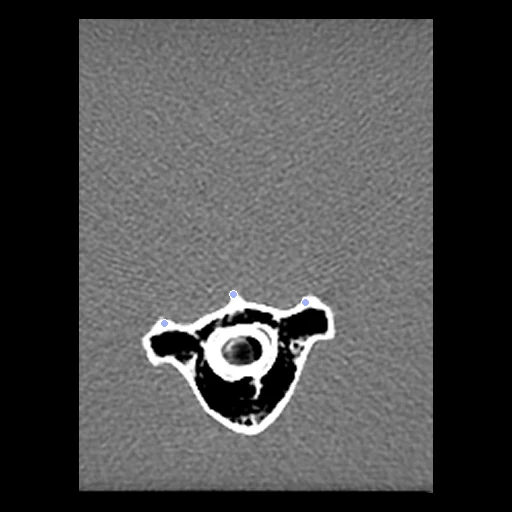
CT and acquired 3D ultrasound of a canine or lamb vertebra phantom, each in its own frame, with the authors' corresponding landmarks, for a rigid CT to ultrasound registration from the provider's pose.
Read before comparing (5)
- Images. The original CT.nii and US.nii named in Landmarks.tag, byte for byte, their RAS coordinates converted to ITK's LPS. The deposit's corrected NIfTI files have other origins, do not match the supplied coordinates and are not used.
- Alignment. Nothing is resampled and no transform is fitted: "aligned": true only says the corpus aligns nothing. The ultrasound stays on its own grid, in the provider's frame, and the two frames do not overlap.
- Truth. 21 landmark pairs a phantom, placed by the authors for a fiducial registration, their silver standard. Lamb pairs 2, 7 and 14, with a point outside US.nii, are excluded without clamping; the first six valid pairs are not scored either, leaving 15 canine and 12 lamb pairs.
- Baseline. The scored landmarks start 252 mm (canine) and 137 mm (lamb) apart. The best rigid fit on them leaves 2.6 and 3.3 mm, the floor any method meets, and turns the lamb's ultrasound by 86 degrees, the canine's by 5.
- Task. run.sh is given FIDOPT_REGISTRATION=rigid and runs its rigid stage alone; only methods that can do so are run. Two ex-vivo phantoms of rigid bone are no clinical cohort: the task is ranked apart.
| Accuracy | Smoothness | Cost | ||||||||
|---|---|---|---|---|---|---|---|---|---|---|
| # | Method | TRE mm | Change | rTRE | SDlogJ | Folds % | Time s | RAM GB | GPU GB | Images |
| 11–3 | NiftyRegCPUappnote | 16.05 ±162.62 | −178.53 | 0.0834 ±0.7546 | 0.000 | 0.00 | 39 | 0.8 | ||
| 21–3 | greedyCPUappnote | 27.85 ±107.41 | −166.73 | 0.1614 ±0.2321 | 0.000 | 0.00 | 8 | 0.9 | ||
| 31–3 | ANTs SyNCPUappnote | 25.95 ±173.46 | −168.63 | 0.1434 ±0.6685 | 0.000 | 0.00 | 8 | 0.3 | ||
| No registration | 194.58 ±726.93 | 1.2690 ±7.4856 | 0.000 | 0.00 | ||||||
The order averages each method's ranks on TRE mm, SDlogJ, so the first one is not always the best in every column. ± is the 95% interval of the mean over the 2 pairs. Two neighbours are tied when a paired Wilcoxon test on the shared pairs does not find the upper one better on TRE mm (5%): the places a method could hold are then shown under its own. The best value of each column is in colour. Click a row to see its images, a column title to sort by it. Time and memory measured on Laptop.
NiftyReg. reg_aladin -rigOnly from the image centres: 3.25 mm on the canine phantom, against a floor of 2.6 mm (the best rigid fit on the scored points); fails on the lamb (86 degrees of rotation).
greedy. Rigid stage alone (dof 6, NMI across CT and ultrasound, image centres): 19.4 mm on the canine phantom, 36.3 mm on the lamb (86 degrees of rotation). From the landmark fit itself NMI runs away, so its metric, not its start, fails on CT/US here.
ANTs SyN. Rigid stage alone (centres of mass, MI). Every rigid method fails on the lamb, whose ultrasound is turned 86 degrees from the CT: none of the rigid stages searches rotations that large from a centre start. The lamb's ultrasound landmarks also sit on dim voxels (median about the image median, against the top 1% on the canine), so its truth may be weaker.
TRE: distance between matching landmarks. rTRE: the TRE over the length of the image's diagonal, to compare datasets of other sizes and units. SDlogJ: how irregular the deformation is, 0 is perfectly smooth. Folds: share of the image where the deformation folds over itself.
Pair by pair
Click a score to look at that result: the fixed image, and over it the moving image after registration, with the annotations. Underlined scores have their image; for the others you see the pair without the result. A green cell gained against no registration on that pair, a red one lost.
About the data
- Test pairs
- Both released real-ultrasound phantom pairs are test cases, and no development case is made from these two specimens. The three human CT and simulated-ultrasound subjects are another task and are not included.
- Truth
- landmarks by experts The provider supplies 21 CT-US landmark pairs per phantom, placed by the authors, who used them for a fiducial registration as their silver standard. Pairs with a point outside its image are excluded (lamb 2, 7, 14); the first six valid pairs, the initialisation pairs of the first build, are not scored either; the remaining 15 canine and 12 lamb pairs are the scored references.
- Licence
- CC BY 4.0