 fidopt
PIANO hand MRI
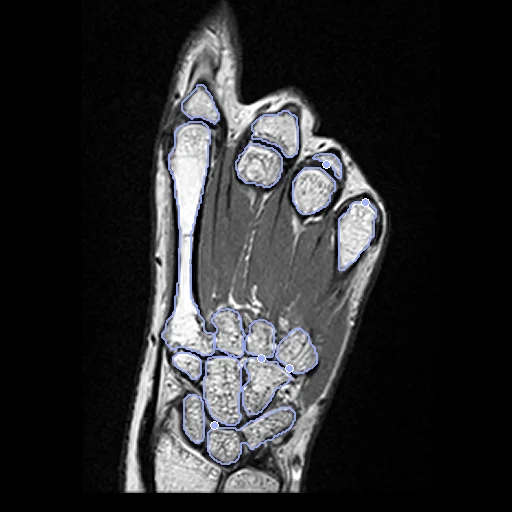
T1-weighted MR of one person's right hand in two poses, each held in a mould, paired by us (PIANO hand MRI dataset, part 1).
Read before comparing (10)
- People. The release, part 1 of PIANO, holds 50 T1 scans without the person or pose of each. The corpus grouped them by their bones, which no pose changes. Around the second and third metacarpals one person's volumes correlate 0.60 to 0.92, two people at most 0.72 (median 0.37); a look at the bones settled the closest calls. The grouping is ours.
- Pairs. A pair is named by its two volumes' numbers, fixed first. Poses go from two open hands (16_25) to an open hand and a fist (17_18, 22_20). Both volumes keep their own grids: after the start, 18 of the 250 moving joints of the test pairs lie outside the fixed grid (up to 7 on 08_07).
- Images. 3 T United Imaging uMR780, the hand set in a hardening mould. Every volume is a right hand; no image is flipped. The volumes come on their own grids, 0.19 to 0.51 mm in plane and 1 mm slices, 5 of the paired ones oblique, with no unit.
- Truth. A network labelled every volume's 25 points and bone mask; radiologists checked them and annotated by hand the volumes it got wrong, about a third. The points are numbered as the repository's piano_joint_id.png and read in mm in ITK's LPS frame, where they sit on the bones. Along the slice axis a point is known to half a millimetre at best.
- Truth error. None is published. The length of a bone between its two joints differs between a pair's volumes by 0.8 to 2.9 mm RMS over the 19 bones (median 2.5 mm), up to 7.3 mm on one proximal phalanx: a joint centre on a bent finger is placed to a few millimetres.
- Mask. One label holds every bone of the hand and stops about a centimetre above the wrist point, so overlap cannot tell the bones apart: the board ranks the joints, not Dice or HD95. A hand's two masks differ in volume by up to 16% (48_49), so a Dice of 1 is out of reach.
- Alignment. As delivered the joints of a pair are 26 to 90 mm apart. Each pair gets one rigid elastix start on mutual information inside each hand, written in the moving headers; no joint or mask is used and no voxel resampled. Rigid, not a translation, because a hand in another pose lies turned in the mould.
- Baseline. With no registration the 10 test pairs leave a landmark error of 35.2 mm (16.2 to 52.7), a bone Dice of 0.38 (0.03 to 0.59) and an HD95 of 32.3 mm (15.4 to 46.3). On a fist against an open hand (03_04) the start misses even the palm.
- Motion. Each bone moves rigidly its own way; fingers turn by tens of degrees, touching fingers part, and the soft tissue folds. A smooth field can follow the palm, not two fingers moving apart.
- Outside numbers. None: PIANO and NIMBLE register a bone template to each scan. No other dataset of the corpus holds a hand.
| Accuracy | Smoothness | Cost | ||||||||||
|---|---|---|---|---|---|---|---|---|---|---|---|---|
| # | Method | TRE mm | Change | Dice * | HD95 mm * | rTRE | SDlogJ | Folds % | Time s | RAM GB | GPU GB | Images |
| 1 | ConvexAdam (MIND)GPUapp | 33.00 ±7.75 | −2.18 | 0.536 ±0.141 | 30.39 ±8.65 | 0.1352 ±0.0397 | 0.165 | 2.44 | 18 | 3.2 | 5.3 | |
| 1 | DemonsCPUapp | 33.53 ±7.24 | −1.65 | 0.396 ±0.131 | 29.72 ±8.22 | 0.1373 ±0.0384 | 0.106 | 0.45 | 17 | 2.7 | ||
| No registration | 35.19 ±7.57 | 0.379 ±0.146 | 32.25 ±7.52 | 0.1442 ±0.0405 | 0.000 | 0.00 | ||||||
The order averages each method's ranks on TRE mm, SDlogJ, so the first one is not always the best in every column. ± is the 95% interval of the mean over the 10 pairs. Two neighbours are tied when a paired Wilcoxon test on the shared pairs does not find the upper one better on TRE mm (5%): the places a method could hold are then shown under its own. The best value of each column is in colour. Click a row to see its images, a column title to sort by it. Time and memory measured on Laptop.
* shown, not ranked: on this dataset it is checked against the output of a program.
Dice: how much the organ contours overlap, 1 is perfect. HD95: distance between the contours' surfaces. TRE: distance between matching landmarks. rTRE: the TRE over the length of the image's diagonal, to compare datasets of other sizes and units. SDlogJ: how irregular the deformation is, 0 is perfectly smooth. Folds: share of the image where the deformation folds over itself.
Pair by pair
Click a score to look at that result: the fixed image, and over it the moving image after registration, with the annotations. Underlined scores have their image; for the others you see the pair without the result. A green cell gained against no registration on that pair, a red one lost.
About the data
- Test pairs
- The 10 pairs outside development and 2 development pairs, one person a pair, from the 12 people the corpus found in 2 to 5 volumes each. A pair is the first two of a person's volumes in the order of sha256("2026:HandMR:<volume>"). The 13 volumes that match no other clearly enough are left out.
- Truth
- landmarks by a program, verified by people contours by a program, verified by people the dataset's bone mask on each image, the carpal bones, metacarpals and phalanges in one label (1): shown, not ranked the dataset's 25 points of the hand on each image, paired by their number: the centres of the 19 joints of the thumb and fingers (carpometacarpal, metacarpophalangeal and interphalangeal), the 5 fingertips and a point at the wrist
- Source
- github.com/reyuwei/PIANO_mri_data
liyuwei.cc/proj/piano
doi.org/10.24963/ijcai.2021/113
arxiv.org/abs/2202.04533
github.com/reyuwei/PIANO_model - Licence
- Apache-2.0 (the licence of the repository that releases the dataset)
2 pairs for tuning, never tested
48_49, 14_15