 fidopt
Ex vivo medial temporal lobe MRI (Penn)
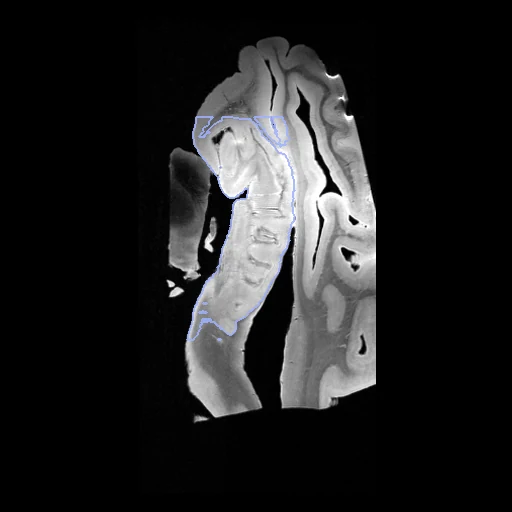
Fixed temporal lobe specimens of two donors from one brain bank, T2-weighted MR at 9.4 T and 0.2 mm, with the medial temporal lobe cortex segmented on each (OpenNeuro ds004767, Ravikumar et al. 2024).
Read before comparing (7)
- Pool. 55 specimens of 55 donors aged 57 to 99, most on the Alzheimer's disease continuum: 34 from the University of Pennsylvania's brain bank (CNDR) and 21 from the University of Castilla-La Mancha's (HNL), scanned ex vivo at 9.4 T. A case pairs two specimens of one bank.
- Images. The release's files in the space of its segmentations, copied as they are: 0.2 mm, 32-bit floats, each on its own grid. The intensity scale differs by three orders of magnitude between specimens, the 99th percentile running from about 80 to 124,000 on the test cases, several capped at 1000. A method has to normalise each image itself.
- Labels. Value 1 is the cortical ribbon from the hippocampus to the collateral sulcus; 2, the release's 3, a smaller part beside it that the release labels apart. The release names no values: the names are the corpus's reading of the paper's protocol. Its values 2 and 4, small regions at the ends of the ribbons absent from many specimens, are set to 0.
- Scored region. The ribbons end on flat cuts where the protocol stops, not on an anatomical border, and only this cortex is labelled: the score says nothing of the rest of the specimen.
- Alignment. None: each specimen keeps its native grid, turned to one orientation by the provider. As delivered, the ten test pairs start at a Dice of 0.33 (0.12 to 0.44), at least as good as an elastix translation on every pair (0.18, 0.00 to 0.42) and better than the image centres put together (0.29).
- Baseline. ConvexAdam with MIND reached a Dice of 0.63 (0.48 to 0.74) on the test pairs, run from a former start fitted on the label maps, which handed the truth to the start (cortex Dice 0.49).
- Specimens. Fixed and scanned out of the skull, the tissue is cut, torn or missing in places, and the provider mirrored specimens where needed so that all look like one side. Nothing here transfers to in vivo MR without care.
| Accuracy | Smoothness | Cost | ||||||||
|---|---|---|---|---|---|---|---|---|---|---|
| # | Method | Dice | Change | HD95 mm | SDlogJ | Folds % | Time s | RAM GB | GPU GB | Images |
| 1 | DemonsCPUapp | 0.393 ±0.101 | +0.067 | 6.93 ±2.53 | 0.061 | 0.00 | 46 | 7.0 | ||
| No registration | 0.326 ±0.074 | 7.58 ±2.66 | 0.000 | 0.00 | ||||||
The order averages each method's ranks on Dice, HD95 mm, SDlogJ, so the first one is not always the best in every column. ± is the 95% interval of the mean over the 10 pairs. Two neighbours are tied when a paired Wilcoxon test on the shared pairs does not find the upper one better on Dice (5%): the places a method could hold are then shown under its own. The best value of each column is in colour. Click a row to see its images, a column title to sort by it. Time and memory measured on Laptop.
Dice: how much the organ contours overlap, 1 is perfect. HD95: distance between the contours' surfaces. SDlogJ: how irregular the deformation is, 0 is perfectly smooth. Folds: share of the image where the deformation folds over itself.
Pair by pair
Click a score to look at that result: the fixed image, and over it the moving image after registration, with the annotations. Underlined scores have their image; for the others you see the pair without the result. A green cell gained against no registration on that pair, a red one lost.
About the data
- Test pairs
- 10 test pairs drawn with seed 2026 among the 26 pairs outside development, by brain bank: 6 from CNDR and 4 from HNL. Each specimen is in one pair only, so none is in both sets. CNDR08 and CNDR31 are left out, with no image in the space of their label map, and one HNL specimen stays unpaired.
- Truth
- contours by a program, verified by people the release's segmentation of each specimen: interpolated between hand-traced slices or started by a network, then checked and corrected by hand on every specimen
- Source
- openneuro.org/datasets/ds004767
doi.org/10.18112/openneuro.ds004767.v1.0.0
s3.amazonaws.com/openneuro.org/ds004767/README
doi.org/10.1038/s41467-024-49205-0
doi.org/10.1186/s40478-021-01275-7 - Licence
- CC0 (the release's dataset_description.json)
10 pairs for tuning, never tested
CNDR14_CNDR15, CNDR13_CNDR04, CNDR03_CNDR29, HNL13_HNL02, CNDR26_CNDR11, CNDR02_CNDR25, HNL19_HNL17, CNDR22_CNDR32, HNL15_HNL11, CNDR19_CNDR09