 fidopt
DeepLIIF, IHC to DAPI with known deformation
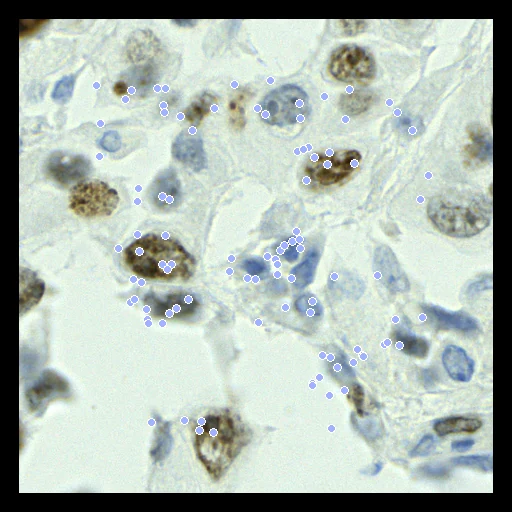
A 2D lung or bladder tile of one tissue section: Ki67 IHC (fixed) and DAPI (moving) as the authors registered them, the DAPI then deformed by a known warp (DeepLIIF).
Read before comparing (7)
- Images. The provider PNG holds six panels of 512 x 512; only the IHC (fixed, RGB as delivered) and the DAPI (moving, one of its three equal planes) are used. The segmentation panels are not used as labels.
- Start. The authors' registration of the IHC and immunofluorescence images is the start, not a truth. By the nuclei of the two stains, what is left is mostly one shift a tile: 12.3 pixels on Bladder_38000_38000_0_2, 8.2 on Bladder_48000_62000_0_0, 3.2 to 5.9 on the eight lung test tiles, under 2.6 on nine development tiles (6.3 on Lung_22000_42000_0_1). It is the floor of the landmark error.
- Warp. The PNGs carry no calibration, so the unit is the pixel and amplitude_mm and spacing_mm are pixels: B-spline coefficients within 64 pixels on knots 160 pixels apart, the same for every tile. It moves a point by 12.7 to 36.2 pixels on average on the test tiles (mean 20.5), against nuclei some 30 to 40 pixels across.
- Recoverable. A crude block matching of the nuclei at the landmarks (64-pixel patches, NCC) brings the median error down to 4 to 13.5 pixels on the test tiles, within about a pixel of each tile's provider shift, and to 1.9 to 6.5 pixels on the development tiles.
- ANTs. SyN as run for LUMIR ends at 15.4 pixels on average against 20.5 with no registration: better on nine test tiles, worse on Bladder_48000_62000_0_0 (37.4 against 36.2), the largest warp. The warp's slow part is nearly affine, out of SyN's reach from the identity: with an affine stage first, that tile falls to 20.0 pixels and Lung_26000_28000_1_0 from 16.0 to 6.6.
- Border. Where the warp reads outside the tile the warped DAPI is filled with its minimum, a band of up to about 60 pixels; the landmarks stay 64 pixels or more inside.
- Public. One tile a parent region reduces local duplication but does not make patients independent. The source has few slides and may have been seen by published models.
No method has a result on every pair of this dataset yet.
| Accuracy | Smoothness | Cost | ||||||||
|---|---|---|---|---|---|---|---|---|---|---|
| # | Method | TRE px | Change | rTRE | SDlogJ | Folds % | Time s | RAM GB | GPU GB | Images |
| No registration | 20.49 ±4.44 | 0.0283 ±0.0061 | 0.000 | 0.00 | ||||||
TRE: distance between matching landmarks. rTRE: the TRE over the length of the image's diagonal, to compare datasets of other sizes and units. SDlogJ: how irregular the deformation is, 0 is perfectly smooth. Folds: share of the image where the deformation folds over itself.
Pair by pair
Click a score to look at that result: the fixed image, and over it the moving image after registration, with the annotations. Underlined scores have their image; for the others you see the pair without the result. A green cell gained against no registration on that pair, a red one lost.
About the data
- Test pairs
- 10 test tiles drawn with seed 2026 from the provider's test set and 10 development tiles from its training set, one tile per parent region (organ, x, y), no region in both. The file names give no slide or patient, so patient independence is unknown.
- Truth
- landmarks a known deformation 100 points a tile, drawn where DAPI is bright, 64 pixels or more from the border, and carried exactly through the known warp. They measure how well a method undoes that warp on top of the authors' own registration of the two images, which they take as exact: it is not. By the nuclei of the two stains (cross-correlation of the band-passed IHC absorbance and DAPI) the IHC and the DAPI of a tile are off by a near-uniform shift of 3.2 to 12.3 pixels on the ten test tiles (median 4.5) and 0.3 to 6.3 on the development tiles, with 1 to 2 pixels more from place to place in the tile. A method that aligns the tissue perfectly therefore scores that shift, not 0.
- Licence
- CC BY 4.0, Zenodo data record. The separate software licence does not replace the data licence.
10 pairs for tuning, never tested
Bladder_22000_40000_0_0, Bladder_22000_42000_1_1, Bladder_22000_44000_2_3, Bladder_22000_52000_0_0, Lung_22000_42000_0_1, Lung_22000_44000_2_1, Lung_24000_16000_0_3, Lung_24000_20000_3_0, Lung_24000_26000_1_2, Lung_24000_28000_0_3