 fidopt
CT-ORG, pairs of patients
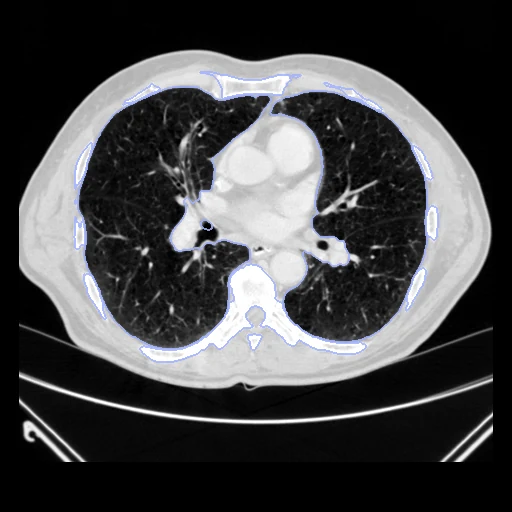
CT scans of two patients from CT-ORG, each on its own grid, with up to six organs labelled: liver, urinary bladder, lungs, kidneys, bone and brain.
Read before comparing (6)
- Pool. prepare.py leaves out scans already in CTORG or MSD_Liver, and all twenty scans of 3D-IRCADb-01, whose geometry was lost and whose licence is CC BY-NC-ND 4.0. Test and development use disjoint source scans.
- Truth. People drew or corrected the test labels. In the provider training set used for development, lungs and bones come from morphological algorithms, another standard than the test truth's.
- Pairs. Several test pairs reuse a patient, so their scores are correlated: the ten pairs are not ten independent groups.
- Alignment. The moving CT's and labels' headers carry one elastix translation on mutual information inside each body, no label used. Both scans keep their voxels and grids, in Hounsfield units at the scanner's voxel size.
- Baseline. With no registration the ten test pairs start at a mean Dice of 0.41 (0.10 to 0.54) over the labels both maps hold, and an HD95 of 81 mm (26 to 179). Scans seldom cover the same part of the body: bone and lung labels are cut where each scan ends, and a perfect registration stays under a Dice of 1 on them.
- case_19_case_5. An abdomen and pelvis placed on a whole body, ambiguous along the body axis for mutual information: the start puts the pelvis on the pelvis but leaves the kidneys' centres 23 mm, the liver's 55 mm and the bladder's 8 mm apart, Dice 0.10. It is the best of every start tried.
No method has a result on every pair of this dataset yet.
| Accuracy | Smoothness | Cost | ||||||||
|---|---|---|---|---|---|---|---|---|---|---|
| # | Method | Dice | Change | HD95 mm | SDlogJ | Folds % | Time s | RAM GB | GPU GB | Images |
| No registration | 0.410 ±0.095 | 81.09 ±42.13 | 0.000 | 0.00 | ||||||
1 result not ranked: an older run, pairs still missing, or a failure on every pair
| Accuracy | Smoothness | Cost | |||||||||
|---|---|---|---|---|---|---|---|---|---|---|---|
| # | Method | Dice | Change | HD95 mm | SDlogJ | Folds % | Time s | RAM GB | GPU GB | Machine | Images |
| ConvexAdam (MIND)GPUapp3/10 pairs | 0.509 ±0.545 | +0.099 | 91.53 ±147.03 | 0.149 | 3.38 | 42 | 5.4 | 13.7 | Laptop | ||
Dice: how much the organ contours overlap, 1 is perfect. HD95: distance between the contours' surfaces. SDlogJ: how irregular the deformation is, 0 is perfectly smooth. Folds: share of the image where the deformation folds over itself.
Pair by pair
Click a score to look at that result: the fixed image, and over it the moving image after registration, with the annotations. Underlined scores have their image; for the others you see the pair without the result. A green cell gained against no registration on that pair, a red one lost.
About the data
- Test pairs
- Ten test pairs from eight people: the eight provider test scans left once CTORG's and MSD_Liver's cases are out, paired in a seeded ring with two more cross-pairs. Ten development pairs use twenty distinct provider training scans. prepare.py defines both pools and their seeded order.
- Truth
- contours by a program, verified by people
- Source
- www.cancerimagingarchive.net/collection/ct-org
doi.org/10.7937/tcia.2019.tt7f4v7o
www.cancerimagingarchive.net/wp-content/uploads/ctorg_README.txt
doi.org/10.1038/s41597-020-00715-8
github.com/bbrister/ctOrganSegmentation
arxiv.org/abs/1901.04056
www.ircad.fr/research/data-sets/liver-segmentation-3d-ircadb-01 - Licence
- CC BY 3.0
10 pairs for tuning, never tested
case_96_case_95, case_135_case_78, case_65_case_51, case_67_case_120, case_101_case_54, case_91_case_113, case_49_case_111, case_127_case_131, case_89_case_56, case_128_case_134