 fidopt
COph100
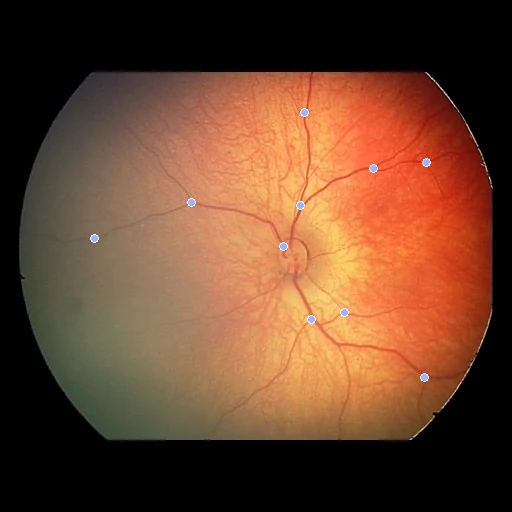
Colour retinal photographs of one eye of an infant screened for retinopathy of prematurity, at the last (fixed) and first (moving) of two to nine sessions 2 to 51 weeks apart (COph100, photographs from RIDIRP).
Read before comparing (7)
- Photographs. RIDIRP's photographs from the University Hospital Ostrava, all with a RetCam 3 and its 130-degree lens: 640 x 480 pixels, a circular field on a black ground, kept in colour as the camera's JPEG from RIDIRP's images.zip, not COph100's re-encoded copies. COph100 picked its eyes to be harder than FIRE: blur, lesions or eyelids in the way, changes of light, rotation, small overlap.
- Units. The camera gives no pixel size, so every distance is in pixels and prepare.py sets every spacing to 1. The rTRE divides the error by the image diagonal, 800 pixels.
- Cases. The fixed image is the eye's last session and the moving image its first, as the paper registers the earlier examination to the later; the middle sessions and the other eye stay out. The groups follow the diagnosis RIDIRP's ophthalmologists gave each session; haemorrhages can fade from one session to the next.
- Truth. Ten points a photograph, placed by hand by COph100's authors, mostly around vessel crossings and numbered alike in every session of an eye; nobody says they were checked. A quadratic map fitted to a case's ten pairs leaves a median of 1.5 px (0.4 to 6.0) over the 56 cases: good to about 2 px where the vessels are sharp, silent between the points.
- Point errors. Comparing each eye's sessions found duplicated numbers in three files and misplaced points in four sessions. prepare.py restores point 3 of 050-1's last session and leaves out point 10 of 051-1's, which keeps nine pairs; neither case is in the split, and the other errors lie in sessions no case uses.
- Baseline. No transform is computed: as delivered the test pairs' points lie 44.3 px apart (10.4 to 93.9), an rTRE of 0.055, turned by up to 26 degrees, closer than after an elastix translation (55.8 px) on 8 of the 10 pairs. The turn is left to the methods.
- Outside numbers. None: the paper scores homographies on its 491 session pairs as delivered, other pairs and another start. The dataset's vessel masks come from a network and are not used.
| Accuracy | Smoothness | Cost | ||||||||
|---|---|---|---|---|---|---|---|---|---|---|
| # | Method | TRE px | Change | rTRE | SDlogJ | Folds % | Time s | RAM GB | GPU GB | Images |
| 11–2 | vismatch matchers · RoMaGPU | 5.58 ±2.44 | −38.74 | 0.0070 ±0.0031 | 0.015 | 0.00 | 12 | 3.2 | 6.8 | |
| 21–2 | vismatch matchers · XFeatGPU | 5.49 ±2.30 | −38.83 | 0.0069 ±0.0029 | 0.026 | 0.00 | 3 | 2.1 | 0.4 | |
| 33–6 | vismatch matchers · LoFTRGPU | 16.47 ±18.19 | −27.85 | 0.0206 ±0.0227 | 0.008 | 0.00 | 3 | 2.1 | 1.7 | |
| 43–6 | vismatch matchers · DISK + LightGlueGPU | 8.42 ±3.01 | −35.91 | 0.0105 ±0.0038 | 0.018 | 0.00 | 3 | 2.1 | 2.9 | |
| 53–6 | vismatch matchers · SIFT + LightGlueGPU | 7.85 ±3.96 | −36.48 | 0.0098 ±0.0050 | 0.046 | 0.00 | 3 | 2.0 | 0.5 | |
| 63–6 | vismatch matchers · ALIKED + LightGlueGPU | 32.65 ±36.73 | −11.68 | 0.0408 ±0.0459 | 0.640 | 0.64 | 3 | 2.3 | 1.7 | |
| No registration | 44.33 ±18.24 | 0.0554 ±0.0228 | 0.000 | 0.00 | ||||||
The order averages each method's ranks on TRE px, SDlogJ, so the first one is not always the best in every column. ± is the 95% interval of the mean over the 10 pairs. Two neighbours are tied when a paired Wilcoxon test on the shared pairs does not find the upper one better on TRE px (5%): the places a method could hold are then shown under its own. The best value of each column is in colour. Click a row to see its images, a column title to sort by it. Time and memory measured on Laptop.
TRE: distance between matching landmarks. rTRE: the TRE over the length of the image's diagonal, to compare datasets of other sizes and units. SDlogJ: how irregular the deformation is, 0 is perfectly smooth. Folds: share of the image where the deformation folds over itself.
Pair by pair
Click a score to look at that result: the fixed image, and over it the moving image after registration, with the annotations. Underlined scores have their image; for the others you see the pair without the result. A green cell gained against no registration on that pair, a red one lost.
About the data
- Test pairs
- 10 test pairs drawn with seed 2026 among the 46 eyes outside development, by diagnosis group in proportion: 4 with retinal haemorrhages at both sessions, 4 physiological at both, 2 with retinopathy of prematurity or another disease. 10 development pairs. One eye an infant, the first of its eyes in the seeded order, so no two cases share an infant.
- Truth
- landmarks by experts the dataset's ten points on every photograph, placed by hand by its authors, mostly around vessel crossings, and numbered alike in all the sessions of an eye: ten pairs a case
- Source
- doi.org/10.6084/m9.figshare.27061084
doi.org/10.1038/s41597-025-04426-w
pmc.ncbi.nlm.nih.gov/articles/PMC11742693
doi.org/10.6084/m9.figshare.c.6626162.v1
doi.org/10.6084/m9.figshare.24565681
doi.org/10.1038/s41597-024-03409-7 - Licence
- CC BY 4.0
10 pairs for tuning, never tested
010, 033, 055, 017, 070-1, 009, 028, 007, 056-1, 011