 fidopt
AIND SmartSPIM whole mouse brains, two channels
Two channels of one cleared whole mouse brain, imaged by SmartSPIM light-sheet and fused on one grid: 488 nm fixed, 639 nm moving and deformed by a known smooth transform (Allen Institute for Neural Dynamics).
Read before comparing (9)
- Source. The public bucket s3://aind-open-data, read over HTTPS without an account; sources.json names each case's asset. Each of the 43 assets used states CC-BY-4.0, as the AWS Open Data registry does; the AIND data page states no licence.
- Pool. The latest stitched asset of each of the 441 subjects of project AIBS WB AAV Toolbox stitched since June 2025, kept when it follows the current protocol: nine-level BigStitcher-Spark fusion, channels Ex_488, Ex_561 and Ex_639, uint16 zstd, and the standard mounting, a level-3 grid at least 600 voxels wide in x and at most 1200 long in y. 273 brains pass.
- Clean brains. At level 6 the 488 nm foreground must hold 420 to 650 mm^3 and touch no face of the volume over more than 10% of it, and fewer than 1% of the voxels more than 5 voxels outside it may exceed a fifth of the brain's median in either channel. That last test catches tile slabs beside 41 brains and 7 oversized foregrounds; 227 pass.
- Level. Each case is the whole brain at the provider's level 3, 14.4 x 14.4 x 16 µm, about 5 x 10^8 voxels a channel; a method that reads no OME-Zarr gets the built store's level 2, 57.6 x 57.6 x 64 µm, within 2^24 voxels. The first voxel lies at the origin; nothing depends on anatomical directions, which vary with the mounting.
- Channels. The three channels share one bounding box, voxel for voxel; no metadata names a stain. Each shows autofluorescence with its own contrast, plus the brain's labels: a nuclear GFP line or viral reporter at 488 nm in some, viral reporters at 561 or 639 nm in others. The shared autofluorescence helps a method that treats both as one modality.
- Truth. Synthetic, ranked apart: a cubic B-spline drawn per case, knots every 1500 µm and coefficients under 500 µm, deforms the 639 nm channel, and 300 points in the 488 nm foreground are paired through it. It measures no real deformation between brains or to an atlas. 7 of the first 20 cases' 6000 points, at the brainstem's cut, pair just outside the moving grid.
- Starting agreement. Before the warp the channels agree within a voxel: cross-correlation finds global offsets of 0.8 µm (823898) and 1.7 µm (824662), block offsets of at most 9.5 µm, and a known shift to within 0.7 µm. This is the truth's own error, about 40 times smaller than the warp.
- Baseline. With no registration the first ten test pairs score a TRE of 151.2 µm (135.6 to 164.9), rTRE 0.0069: 10.5 voxels of the built level, 2.6 of the level given within 2^24 voxels. Over the 23 test pairs the points move by 130 to 168 µm at a case's median, 150 on average.
- Overlap. No other dataset of the corpus reads aind-open-data, SmartSPIM or Allen Institute data (every descriptor and prepare.py searched). With one asset a subject, no animal is in both test and development.
| Accuracy | Smoothness | Cost | ||||||||
|---|---|---|---|---|---|---|---|---|---|---|
| # | Method | TRE µm | Change | rTRE | SDlogJ | Folds % | Time s | RAM GB | GPU GB | Images |
| 1 | anatomix + ConvexAdamGPUapp | 58.73 ±6.17 | −93.96 | 0.0027 ±0.0003 | 0.072 | 0.04 | 18 | 2.6 | 10.0 | |
| 2 | ConvexAdam (MIND)GPUapp | 61.18 ±5.92 | −91.52 | 0.0028 ±0.0003 | 0.087 | 0.23 | 8 | 2.5 | 2.4 | |
| No registration | 152.69 ±3.65 | 0.0070 ±0.0002 | 0.000 | 0.00 | ||||||
The order averages each method's ranks on TRE µm, SDlogJ, so the first one is not always the best in every column. ± is the 95% interval of the mean over the 23 pairs. Two neighbours are tied when a paired Wilcoxon test on the shared pairs does not find the upper one better on TRE µm (5%): the places a method could hold are then shown under its own. The best value of each column is in colour. Click a row to see its images, a column title to sort by it. Time and memory measured on Laptop.
TRE: distance between matching landmarks. rTRE: the TRE over the length of the image's diagonal, to compare datasets of other sizes and units. SDlogJ: how irregular the deformation is, 0 is perfectly smooth. Folds: share of the image where the deformation folds over itself.
Pair by pair
Click a score to look at that result: the fixed image, and over it the moving image after registration, with the annotations. Underlined scores have their image; for the others you see the pair without the result. A green cell gained against no registration on that pair, a red one lost.
About the data
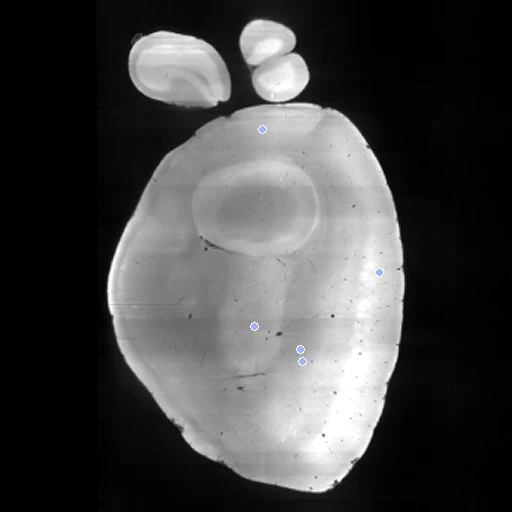
- Test pairs
- 23 test brains drawn with seed 2026 from a pool of 227, then 20 development brains from the 204 left, the last of the same seeded order. One brain is one animal; pool.txt lists the pool and the notes give its rule.
- Truth
- landmarks a known deformation 300 points drawn in the 488 nm channel's foreground, paired through the known deformation of the 639 nm channel
- Source
- registry.opendata.aws/allen-nd-open-data
github.com/awslabs/open-data-registry/blob/main/datasets/allen-nd-open-data.yaml
allenneuraldynamics.github.io/data.html
aind-open-data.s3.amazonaws.com/SmartSPIM_824662_2025-10-20_12-13-30_stitched_2026-08-04_18-27-37/data_description.json
github.com/AllenNeuralDynamics/aind-smartspim-pipeline - Licence
- CC BY 4.0 (each asset's data_description.json, and the AWS Open Data registry entry)
20 pairs for tuning, never tested
823898, 825882, 827555, 866230, 860118, 842478, 868536, 861565, 864780, 824714, 826930, 847928, 825914, 876743, 864061, 869343, 864785, 872321, 830757, 834129