 fidopt
Pediatric T1 MRI with and without previous ADHD diagnosis
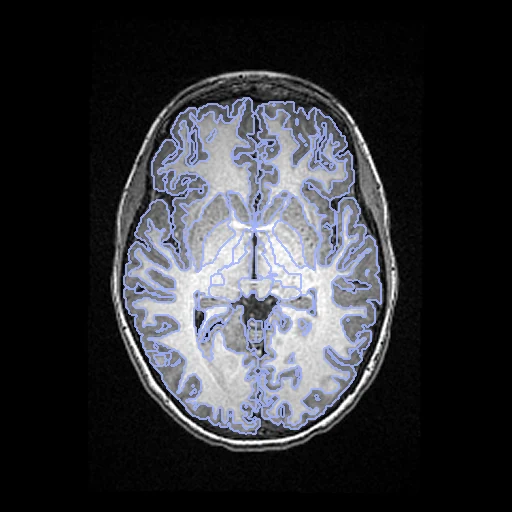
T1 MR of the brains of two different children from OpenNeuro ds002424, with FastSurfer anatomical labels on both; the test children have a parent-reported previous ADHD diagnosis.
Read before comparing (7)
- Diagnosis. ADHD_diagnosis is the participant table's parent- or guardian-reported previous diagnosis at ses-T1, not a clinical adjudication. Controls, with no previous diagnosis reported, appear only in development: a population difference to weigh when tuning.
- Images. Only the defaced ses-T1 T1-weighted scan is used; the study has no longitudinal image pairs. ds003500 is not mixed in, since its subjects' independence from these has not been established.
- Truth. FastSurfer v2.5.4's automatic subcortical and DKT labels, resampled nearest-neighbour onto each native scan grid. They are not manual pediatric annotations: the dataset is kept apart and says nothing of clinical segmentation accuracy.
- Headers. 14 source files (sub-01, 02, 04, 05, 06, 08, 09, 10, 11, 12, 14, 25, 30, 32) carry an sform that differs from their qform by up to 35 mm at the corners. FastSurfer reads the sform, ITK the qform, so labels.py gives FastSurfer a copy with the sform equal to the qform, and the labels lie on the image as ITK reads it.
- Alignment. Each pair starts from an intensity-based elastix rigid transform, no label used, written into the moving image's and its labels' headers. Both images keep their native voxels and grids.
- Baseline. From that start the ten test pairs have a mean Dice of 0.4117 (0.3137 to 0.4693) over the 95 labels and an HD95 of 5.8295 mm (4.3369 to 8.3677). ConvexAdam (MIND) results measured on an earlier label-centroid affine build do not describe these cases.
- Source. The control draw reads the provider's participants.tsv (SHA-256 0ebb4dff7b0bfc926eab5e6c83a6d3e1509efa756a14829c7be53c3e6c404bc8); the T1 files are pinned in source_checksums.json.
| Accuracy | Smoothness | Cost | ||||||||
|---|---|---|---|---|---|---|---|---|---|---|
| # | Method | Dice | Change | HD95 mm | SDlogJ | Folds % | Time s | RAM GB | GPU GB | Images |
| 1 | ConvexAdam (MIND)GPUapp | 0.609 ±0.008 | +0.197 | 3.69 ±0.18 | 0.060 | 0.04 | 12 | 2.6 | 2.9 | |
| 2 | anatomix + ConvexAdamGPUapp | 0.593 ±0.012 | +0.182 | 3.93 ±0.37 | 0.055 | 0.02 | 29 | 3.0 | 12.9 | |
| 33–4 | DemonsCPUapp | 0.485 ±0.048 | +0.073 | 5.30 ±0.86 | 0.054 | 0.00 | 9 | 1.5 | ||
| 43–4 | multiGradICONGPUapp | 0.588 ±0.125 | +0.176 | 8.54 ±11.37 | 0.228 | 9.95 | 97 | 3.2 | 12.5 | |
| No registration | 0.412 ±0.035 | 5.83 ±0.83 | 0.000 | 0.00 | ||||||
The order averages each method's ranks on Dice, HD95 mm, SDlogJ, so the first one is not always the best in every column. ± is the 95% interval of the mean over the 10 pairs. Two neighbours are tied when a paired Wilcoxon test on the shared pairs does not find the upper one better on Dice (5%): the places a method could hold are then shown under its own. The best value of each column is in colour. Click a row to see its images, a column title to sort by it. Time and memory measured on Laptop.
Dice: how much the organ contours overlap, 1 is perfect. HD95: distance between the contours' surfaces. SDlogJ: how irregular the deformation is, 0 is perfectly smooth. Folds: share of the image where the deformation folds over itself.
Pair by pair
Click a score to look at that result: the fixed image, and over it the moving image after registration, with the annotations. Underlined scores have their image; for the others you see the pair without the result. A green cell gained against no registration on that pair, a red one lost.
About the data
- Test pairs
- The 35 ses-T1 subjects with ADHD_diagnosis == 1 were ordered with seed 2026:ADHDChildrenMR:subjects into 17 disjoint pairs, one subject unused; 10 pairs were drawn for test with seed 2026:ADHDChildrenMR, the other 7 kept for development. Three more development pairs take the first six of the 44 controls (ADHD_diagnosis == 0) in SHA-256 order with salt 2026:ADHDChildrenMR:controls. The 40 subjects are distinct.
- Truth
- contours by a program FastSurfer v2.5.4 FastSurferCNN aparc.DKTatlas+aseg.deep, generated locally from each native defaced T1w image; subcortical structures and DKT cortical parcellation. Automatic labels are resampled to the input grid by nearest neighbor. Pediatric domain validity has not been established by manual annotation.
- Source
- openneuro.org/datasets/ds002424/versions/1.2.0
doi.org/10.18112/openneuro.ds002424.v1.2.0
doi.org/10.1016/j.dib.2019.105801 - Licence
- CC0 1.0, as declared by the source dataset_description.json
10 pairs for tuning, never tested
sub-79__sub-12, sub-73__sub-66, sub-25__sub-04, sub-13__sub-29, sub-33__sub-74, sub-71__sub-67, sub-57__sub-06, sub-27__sub-41, sub-65__sub-52, sub-68__sub-23