 fidopt
Prostate-Anatomical-Edge-Cases
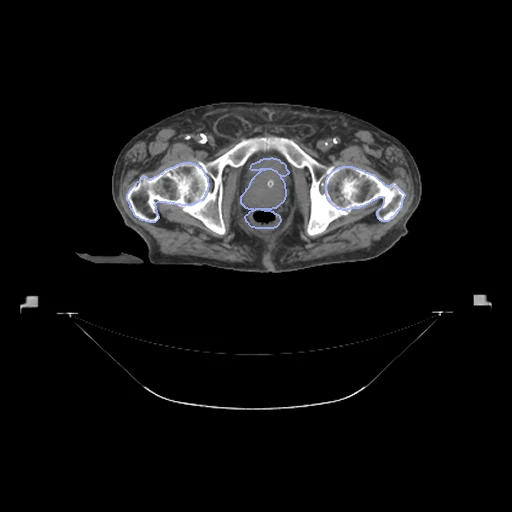
Radiotherapy simulation CT of the pelvis of a man with prostate cancer, most with an anatomical variant chosen to stress autosegmentation, the prostate, bladder, rectum and femoral heads contoured by one radiation oncologist (Prostate-Anatomical-Edge-Cases).
Read before comparing (10)
- Cohort. 131 men treated by external beam radiotherapy at one institution: 112 edge cases with anatomical variants such as an enlarged prostate, drooping seminal vesicles, a hip arthroplasty, a Foley catheter or a hydrogel spacer, and 19 normal cases. One simulation CT each, on one Philips scanner, in Hounsfield units as delivered. Each patient's variants come from the paper's Supplementary Table 2.
- Truth. The clinical contours, drawn by hand by one radiation oncologist with MR for reference where available, peer-reviewed and used for treatment planning. No agreement between readers is reported: graded expert.
- Left out. The rectum is empty on AEC-009, 116, 117, 119, 125, 127 and 134 and the prostate on AEC-072, organs the CT shows, which a method would be charged for. AEC-020 and AEC-111 have a femoral head without contours but are not listed as arthroplasties; neither was drawn.
- Femoral heads. A head without contours, as on the prosthesis side of test case AEC-037, is absent from the truth: labelling the femur there, as TotalSegmentator does, scores a false positive at 0. The heads stop near the lesser trochanter; the slices below the lowest structure are an ignore region, never shown or scored, so the shafts cost nothing.
- Rectum. The clinic's contour, 38 to 81 mm long on the 20 CTs built first, short of the whole rectum: a method that segments its full length is charged for the rest. It differs from the paper's volume on 23 of the 123 patients, smaller on 21 (test CT AEC-081: 34.5 ml against 344.9 ml).
- Shared voxels. The prostate and the bladder share 0.07 to 13.9 ml on the 20 CTs built first, most around AEC-023's catheter. The prostate keeps them, so the bladder label is the bladder outside the prostate.
- Checks. On the test CTs the femoral heads lie on their sides and the prostate in front of the rectum and below the bladder. TotalSegmentator 2.18 on the normal test case AEC-094 scores a prostate Dice of 0.674 and a bladder Dice of 0.927; it has no rectum, which scores 0.
- Room. The paper's commercial tool reached a mean Dice of 0.78 on the normal cohort and 0.12 less on edge cases with several variants; hip prostheses degraded every structure and a catheter the bladder. The surface Dice is at 1 mm, the provider setting no tolerance.
- Exposure. Public since May 2023 and listed by the MedSAM dataset list, IMed-361M and SegBook: a model trained on it may have seen these test cases.
- Overlap. No descriptor of the corpus names the collection, its authors or their institutions; the corpus's pelvic radiotherapy CTs come from Beaumont Health and the SynthRAD centres.
| Accuracy | Cost | ||||||||
|---|---|---|---|---|---|---|---|---|---|
| # | Method | Dice | Surface Dice | HD95 mm | Time s | RAM GB | GPU GB | Machine | Images |
| 11–3 | MONAI wholeBody CTGPUapp3 of 5 structures1 failed | 0.810 ±0.174 | 0.599 ±0.149 | 5.32 ±1.52 | 20 | 3.2 | 15.6 | Laptop | |
| 21–3 | KonfAI segmentation app · TotalSegmentator (total), KonfAI appGPUapp4 of 5 structures | 0.840 ±0.051 | 0.568 ±0.073 | 6.31 ±1.10 | 35 | 7.6 | 7.6 | Workstation | |
| 31–3 | KonfAI segmentation app · TotalSegmentator (total), the authors' packageGPUapp4 of 5 structures | 0.839 ±0.051 | 0.566 ±0.071 | 6.16 ±1.11 | 19.4 | 5.8 | Workstation | ||
| 4 | CT-FM whole-body segmentationGPUapp4 of 5 structures | 0.719 ±0.124 | 0.460 ±0.101 | 23.89 ±22.44 | 103 | 16.9 | 6.9 | Workstation | |
The order averages each method's ranks on Dice, Surface Dice, HD95 mm, so the first one is not always the best in every column. ± is the 95% interval of the mean over the 12 cases. Two neighbours are tied when a paired Wilcoxon test on the shared cases does not find the upper one better on Dice (5%): the places a method could hold are then shown under its own. The best value of each column is in colour. Click a row to see its images, a column title to sort by it.
2 results not ranked: an older run, cases still missing, or a failure on every case
| Accuracy | Cost | ||||||||
|---|---|---|---|---|---|---|---|---|---|
| # | Method | Dice | Surface Dice | HD95 mm | Time s | RAM GB | GPU GB | Machine | Images |
| KonfAI segmentation app · TotalSegmentator (total), KonfAI appGPUapp4 of 5 structuresolder run | 0.840 ±0.051 | 0.568 ±0.073 | 6.31 ±1.10 | 38 | 4.7 | 10.8 | Laptop | ||
| MONAI wholeBody CTGPUapp3 of 5 structuresfailed on every case | 0.000 ±0.000 | 0.000 ±0.000 | Workstation | ||||||
Dice: how much the organ contours overlap, 1 is perfect. Surface Dice: the share of the contours' surfaces within a tolerance of each other, 1 is perfect. HD95: distance between the contours' surfaces.
Case by case
Click a score to look at that result: the image, the truth in green and the method's map in red. Underlined scores have their image; for the others you see the case without the result.
About the data
- Test cases
- 12 test CTs drawn with seed 2026 by the provider's cohorts among the 112 patients outside development: 2 of the 15 normal cases, 1 of the 11 hip arthroplasties and 9 of the 97 other edge cases. 11 development CTs, the last of the same seeded order, each cohort in proportion: 1 normal, 1 hip arthroplasty and 9 other edge cases. The pool is 123 patients: eight whose prostate or rectum has no contour are left out.
- Truth
- contours by experts the clinical structure set, drawn by hand on the simulation CT by one radiation oncologist for all the patients, MR for reference where available, peer-reviewed and used for treatment planning: 1 the prostate, 2 the bladder outside it, 3 the rectum over the length the clinic contours, 4 and 5 the femoral heads down to about the lesser trochanters, none on a side a hip prosthesis replaced; the slices below the lowest structure are the ignore region
- Source
- www.cancerimagingarchive.net/collection/prostate-anatomical-edge-cases
doi.org/10.7937/QSTF-ST65
doi.org/10.1016/j.phro.2023.100413
pmc.ncbi.nlm.nih.gov/articles/PMC9922913 - Licence
- CC BY 4.0
11 cases for tuning, never tested
Prostate-AEC-103, Prostate-AEC-045, Prostate-AEC-036, Prostate-AEC-095, Prostate-AEC-074, Prostate-AEC-126, Prostate-AEC-071, Prostate-AEC-063, Prostate-AEC-115, Prostate-AEC-038, Prostate-AEC-057