 fidopt
PENGWIN CT
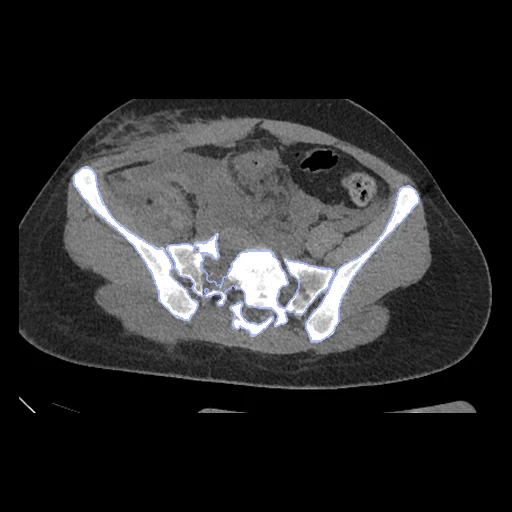
Pelvic CT of a patient with a pelvic fracture before reduction surgery, from six medical centres in China, with the sacrum and the two hip bones labelled (PENGWIN 2024 challenge, task 1).
Read before comparing (6)
- Pool. 150 patients aged 16 to 94, scanned before surgery on seven scanner models, without significant artefact, cropped to the pelvis; the challenge's 100 training CTs are public. The CTs are the provider's files unchanged, in Hounsfield units, some reading -2048 or below outside the scanner's field of view.
- Labels. The dataset labels each fragment of a broken bone. prepare.py merges each bone's fragments into sacrum (1), hip_left (2) and hip_right (3), as the challenge's anatomy scores do: a fragment has no name that holds across patients. What is scored is each bone of a broken pelvis, fracture lines and displaced pieces included. The ten test CTs hold 4 to 9 fragments each.
- Truth. An nnU-Net trained on CTPelvic1K, mostly unbroken pelvises, drew the bones; two annotators each corrected the draft and cut the fragments by hand, and a senior orthopaedic expert chose the better. Graded semi-automatic: the draft's prior may bias it, the authors write. Fragments under 500 mm³ were omitted, so a small loose piece of bone may be background.
- Agreement. A third annotator redid the 30 hidden test CTs from the same draft: the three bones agreed at an IoU of 0.9996 (HD95 1.07 mm), about a millimetre at the surface, the surface Dice's tolerance.
- Sides. hip_left lies on the patient's left in every case built. TotalSegmentator 2.18.0 on test case 006 scores a Dice of 0.93 for each hip bone and 0.81 for the sacrum, 0.90 once its vertebrae_S1, which the dataset's sacrum holds, is counted in.
- Overlap. An image comparison with CTPelvic1K's CLINIC component found 31 shared images under other filenames, 4 of them cropped and flipped; seven built cases are CLINIC images (test 011, 041, 064, 065, 094; development 052, 067). CTPelvic1K_Clinic leaves those and other close candidates out by bone shape and finds no duplicate voxel-wise; the two still share a source cohort and are not independent populations.
| Accuracy | Cost | |||||||
|---|---|---|---|---|---|---|---|---|
| # | Method | Dice | Surface Dice | HD95 mm | Time s | RAM GB | GPU GB | Images |
| 11–5 | KonfAI segmentation app · TotalSegmentator (total), the authors' packageGPUapp | 0.926 ±0.010 | 0.873 ±0.031 | 2.57 ±1.68 | 20.2 | 3.9 | ||
| 21–5 | KonfAI segmentation app · TotalSegmentator (total), KonfAI appGPUapp | 0.925 ±0.009 | 0.871 ±0.031 | 2.55 ±1.62 | 20 | 3.4 | 6.4 | |
| 31–5 | CT-FM whole-body segmentationGPUapp | 0.907 ±0.037 | 0.837 ±0.066 | 21.88 ±15.05 | 101 | 12.6 | 6.4 | |
| 41–5 | KonfAI segmentation app · MRSegmentator, KonfAI appGPUapp3 failed | 0.632 ±0.312 | 0.600 ±0.297 | 4.36 ±0.74 | 40.3 | 5.8 | ||
| 51–5 | MONAI wholeBody CTGPUapp6 failed | 0.367 ±0.339 | 0.332 ±0.307 | 2.60 ±0.70 | 19 | 4.1 | 6.8 | |
The order averages each method's ranks on Dice, Surface Dice, HD95 mm, so the first one is not always the best in every column. ± is the 95% interval of the mean over the 10 cases. Two neighbours are tied when a paired Wilcoxon test on the shared cases does not find the upper one better on Dice (5%): the places a method could hold are then shown under its own. The best value of each column is in colour. Click a row to see its images, a column title to sort by it. Time and memory measured on Workstation.
1 result not ranked: an older run, cases still missing, or a failure on every case
| Accuracy | Cost | ||||||||
|---|---|---|---|---|---|---|---|---|---|
| # | Method | Dice | Surface Dice | HD95 mm | Time s | RAM GB | GPU GB | Machine | Images |
| MONAI wholeBody CTGPUappolder run | 0.912 ±0.010 | 0.835 ±0.035 | 3.05 ±0.69 | 12 | 2.7 | 10.1 | Laptop | ||
Dice: how much the organ contours overlap, 1 is perfect. Surface Dice: the share of the contours' surfaces within a tolerance of each other, 1 is perfect. HD95: distance between the contours' surfaces.
Case by case
Click a score to look at that result: the image, the truth in green and the method's map in red. Underlined scores have their image; for the others you see the case without the result.
About the data
- Test cases
- 10 test CTs drawn with seed 2026 among the 90 of the public training set outside development, and 10 development CTs. One CT a patient; the dataset names no centre or fracture type, so the draw has no strata. The challenge's 20 validation and 30 test CTs are not public.
- Truth
- contours by a program, verified by people the sacrum (1), the left hip bone (2) and the right hip bone (3), each the union of the dataset's fragments of that bone (prepare.py): a network's draft of the three bones corrected by hand and cut into fragments by hand, by two annotators independently, the better of the two chosen by a senior orthopaedic expert
- Source
- zenodo.org/records/10927452
pengwin.grand-challenge.org
arxiv.org/abs/2504.02382
github.com/YzzLiu/PENGWIN-example-algorithm/blob/main/evaluation_CT_core.py - Licence
- CC BY 4.0
10 cases for tuning, never tested
017, 033, 055, 086, 075, 089, 052, 009, 067, 099