 fidopt
TSPO PET/MR in chronic pain (MGH, OpenNeuro ds007907), T1w to [11C]PBR28 PET
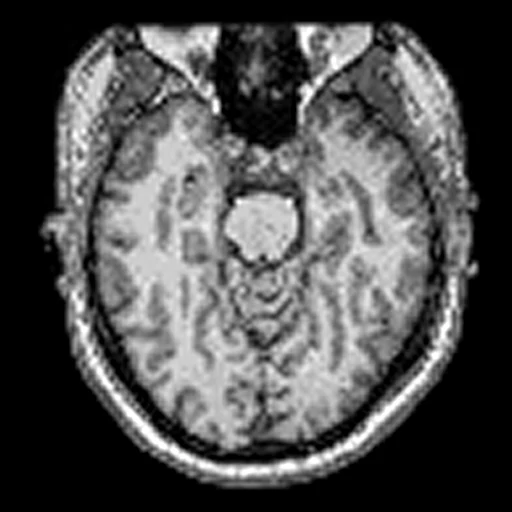
T1-weighted MR of the head (source) and the static [11C]PBR28 PET of minutes 60 to 90 in SUV (target) of one PET/MR session, the T1w resampled onto the PET grid by the provider (OpenNeuro ds007907).
14 test casesbrainsource MR, target PET
Read before comparing (10)
- Cohorts. 147 adults scanned on one Siemens Biograph mMR at Massachusetts General Hospital: 88 with chronic low back pain (51 of the IGNITE study, 37 of the CBD trial before treatment), 37 with knee osteoarthritis and 22 healthy controls. sub-CBD025rep2, sub-CBD055rep2 and sub-CBD070rep2 come only under those names.
- Source. The T1w as delivered: a multi-echo MPRAGE at 3 T on the same scanner, defaced, on FreeSurfer's normalised scale with white matter at 110. The provider coregistered it to the PET and resampled it onto the PET's grid, 344 x 344 x 127 voxels of 2.09 x 2.09 x 2.03 mm, so it keeps no detail finer than 2 mm.
- Target. The static image of minutes 60 to 90 of a 90-minute acquisition, reconstructed by OSEM without a filter and so noisy at the scale of its voxels, attenuation-corrected with a pseudo-CT made from the MPRAGE, in body-weight SUV (g/mL).
- Alignment. The corpus registers nothing. On overlays of six subjects the ventricles, scalp, skull, jaw and neck lie on their anatomy. On 20 subjects a rigid registration on mutual information, started from the provider's alignment, moves the head by 0.3 to 2.0 mm on average, within one PET voxel; the PET's brain has too little contrast to place it more finely than about a voxel.
- Mask. The head where both images hold data: the T1w above Otsu's threshold where the PET is not 0, 2.6 to 4.4 litres a case. It leaves out the provider's leftover background noise, the air of the sinuses and pharynx, and the PET's end slices. The target is scored inside it, and a method is given it.
- Signal. Only high- and mixed-affinity TSPO binders were included, and binding differs between them, a genotype not released and shown by no image: what the T1w does not show counts as error for every method. Inside the test masks the SUV has a median of 0.47 to 1.00, and the hottest voxels reach 3.8 to 11.7 SUV.
- Range. truth.dynamic_range is 5: PSNR and SSIM take the SUV range 0 to 5, which holds 99.94% of the voxels of the 14 test masks. A range set by each case's maximum would follow the hot spots of the jaw and neck rather than the head.
- Baseline. Inside the mask on the 14 test cases, a constant at the target's median scores an MAE of 0.34 (0.25 to 0.52) SUV, a PSNR of 19.8 (15.3 to 22.5) dB and an SSIM of 0.46 (0.36 to 0.58). The source is an MR on FreeSurfer's scale, so it has no MAE as it is.
- Overlap. No other dataset of the corpus holds these subjects; a later dataset of them, for registration, keeps each in its partition or leaves it out. The release's derivatives, skull masks and SUV maps in MNI space, are not used.
- Outside numbers. None: the study measures TSPO in the skull and reports no synthesis.
No method has a result on every case of this dataset yet.
Case by case
Click a score to look at that result: the target image, and over it the method's synthetic image. Underlined scores have their image; for the others you see the case without the result.
About the data
The first test caseClick to look at every case.
- Test cases
- 14 test subjects drawn with seed 2026 from all 147, stratified in proportion by the provider's four cohorts. Then 13 development subjects, the last of the same seeded order, those the test draw rests on kept, each cohort in proportion: 7 from the IGNITE study's chronic low back pain, 2 from the CBD trial, 1 with knee osteoarthritis and 3 healthy controls.
- Truth
- target image as released the static [11C]PBR28 PET of minutes 60 to 90 after the injection, attenuation-corrected, in body-weight SUV (g/mL) as delivered, on its own grid, onto which the provider resampled the T1w it had coregistered to it
- Source
- openneuro.org/datasets/ds007907
doi.org/10.18112/openneuro.ds007907.v1.0.2
s3.amazonaws.com/openneuro.org/ds007907/README.md
s3.amazonaws.com/openneuro.org/ds007907/participants.json
s3.amazonaws.com/openneuro.org/ds007907/derivatives/skull_tspo/dataset_description.json
doi.org/10.1126/scitranslmed.aed8729
doi.org/10.1101/2025.07.19.25331817 - Licence
- CC0
13 cases for tuning, never tested
sub-CLBP052, sub-CLBP017, sub-CLBP036, sub-CLBP076, sub-CLBP070, sub-CBD023, sub-KOA043, sub-CLBP046, sub-HC034, sub-HC022, sub-HC011, sub-CLBP009, sub-CBD067