 fidopt
Monash vis-fPET-fMRI (OpenNeuro ds003382), T1w to FDG-PET
One simultaneous PET/MR session of a healthy adult under a constant FDG infusion: the T1w MPRAGE (source) and the static FDG-PET in Bq/mL (target), on the T1w's grid after a rigid motion correction (OpenNeuro ds003382).
10 test casesbrainsource MR, target PET
Read before comparing (11)
- Cohort. Ten healthy adults, 18 to 49 years, nine women, on a Siemens Biograph mMR. FDG was infused at 36 mL/h from the start of the PET, 39 to 105 MBq. The first 20 minutes, eyes closed, held the attenuation and structural scans, then came blocks of a flickering checkerboard and of rest with fMRI, until 90 or 95 minutes.
- Source. The T1w as delivered: a 1 mm MPRAGE with Siemens' prescan normalisation and distortion correction, defaced by pydeface, in the scanner's arbitrary units.
- Target. The provider's attenuation-corrected static PET of the whole acquisition (rec-acstat), decay-corrected to the start of the infusion, in Bq/mL. Under a constant infusion the activity rises through the scan; the static image is its mean. sub-02 to sub-08 were reconstructed with PSF on 1.39 mm voxels, sub-10 to sub-16 without it on 4.17 mm voxels, which keep less detail.
- Alignment. Both headers place the images in the scanner's frame, but the T1w is a 7-minute snapshot and the PET a mean over 90 to 95 minutes while the head moves. The corpus registered each PET rigidly to the T1w once and keeps the transform in transforms/. prepare.py resamples the native PET through it once; the T1w is never resampled.
- Motion. The correction moves the head by 1.2 to 8.3 mm on average (median 3.0 mm), with rotations up to 2 degrees. A fresh registration of the corrected pairs moves it 0.08 to 0.56 mm, well under a PET voxel. The neck and jaw moving apart from the head, which a rigid transform cannot undo, count as error for every method.
- Mask. The head where both images hold data: the thresholded T1w, its largest part with holes filled, less the face pydeface removed and the PET's zeros; 3.0 to 4.2 litres. The target is scored there, and the method is given it.
- Uptake. FDG uptake follows glucose metabolism, higher in the grey matter and in the visual cortex during the checkerboard, which the T1w does not show. Its level follows the dose and each body, which no image shows: a synthesis must guess each subject's level, and that error counts for every method.
- Range. truth.dynamic_range is 10000, 0 to 10,000 Bq/mL, which holds every voxel of the ten masks; the coolest case, sub-02 at 39 MBq, uses about half of it.
- Baseline. Inside the mask on the ten test cases, a constant at the target's median scores an MAE of 1,430 (850 to 1,827) Bq/mL, a PSNR of 14.7 (12.6 to 18.4) dB and an SSIM of 0.41 (0.33 to 0.51).
- Left out. The release's dynamic PET and list-mode data are not used. From ds002898 or ds003397 a static image would be the corpus's own sum of short frames at other doses: on ds002898's sub-01 it reads about 15,200 Bq/mL in the brain, against 2,600 to 5,200 here.
- Overlap. No other dataset of the corpus holds these subjects. The data were published for fPET-fMRI methods and report no synthesis: no outside number compares.
No method has a result on every case of this dataset yet.
Case by case
Click a score to look at that result: the target image, and over it the method's synthetic image. Underlined scores have their image; for the others you see the case without the result.
About the data
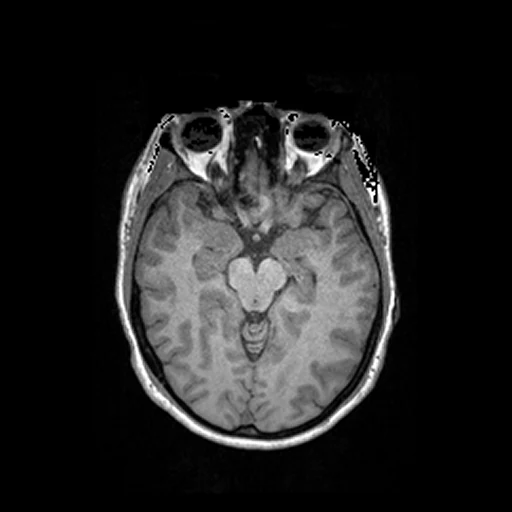
The first test caseClick to look at every case.
- Test cases
- All ten subjects of the release are test cases; none is left for development. The two other Monash PET/MR sets of the screening row, ds002898 and ds003397, hold dynamic PET only and are not used.
- Truth
- target image by a program the static FDG-PET of the session, attenuation-corrected, of the whole acquisition from the start of the infusion (89 to 95 minutes), decay-corrected to its start, in Bq/mL as delivered, brought onto the T1w's grid through the scanner's frame and a rigid correction of the head's motion that the corpus computed once (transforms/)
- Source
- openneuro.org/datasets/ds003382
doi.org/10.18112/openneuro.ds003382.v1.5.0
s3.amazonaws.com/openneuro.org/ds003382/README
doi.org/10.1038/s41597-021-01042-2
doi.org/10.1016/j.neuroimage.2019.01.003
openneuro.org/datasets/ds002898
openneuro.org/datasets/ds003397 - Licence
- CC0