 fidopt
Head Neck CBCT to CT (HUST)
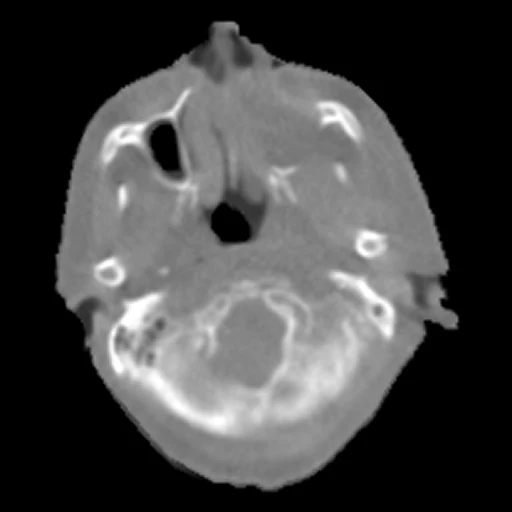
First-day cone-beam CT (source) and planning CT (target) of one head and neck radiotherapy patient, the CBCT registered onto the CT by the corpus (Huazhong University of Science and Technology).
Read before comparing (10)
- Registration. The archive gives each CT and CBCT in its own scanner frame. The corpus registered the CBCT onto the CT with IMPACT-Reg's Elastix_IMPACT_Jacobian preset (impact-reg-konfai 1.8.7, elastix-IMPACT 1.1.0): a mutual-information rigid stage, then a cubic B-spline on TotalSegmentator-network features, mutual information and a bending penalty. The nine cases added later used 1.8.7.dev185, without an explicit rigid stage.
- Check. On the original 20 cases, the TotalSegmentator (task total) structures inside the CBCT field gave a median per-case mean Dice of 0.25 as delivered, 0.80 after the rigid stage and 0.87 after the B-spline (0.73 to 0.89); all 20 were checked by eye. The nine added were checked by transform comparisons, image overlap and overlays.
- Values. Not Hounsfield units, the target's included: the provider scaled each image to 0 to 255, air at 0, by an unstated scale that changes from image to image; the most frequent value in the body reads 66 to 89 on the original 20 CTs. The MAE is in those units, PSNR and SSIM over 255.
- Scale. A method that writes Hounsfield units must rescale, and part of any method's error is each CT's own scale, which nothing in the CBCT gives.
- Mask. The CT's body, holes filled so that airways and sinuses count, where the transform lands inside the CBCT's grid. On the original ten test cases it leaves out 0 to 29% of the CT's body (case103's and case166's CBCTs stop near the skull base); inside it, 0.1% to 1.2% of voxels read 0 in the CBCT and tissue in the CT.
- Anatomy. The CBCT is from the first day of treatment, the CT from planning: the neck bends otherwise, and the mouth and the air in it change. The registration follows only larger changes; residual misalignment, CBCT artefacts and noise count against every method.
- Baseline. Inside the mask on the 15 test cases, a constant at each CT's median scores a median MAE of 10.55 (8.85 to 14.88), a PSNR of 21.58 dB and an SSIM of 0.629; the registered CBCT 10.37 (6.20 to 50.27), 25.59 dB and 0.911, beating the constant on MAE in 7 of 15. A high SSIM need not mean a low MAE.
- ImpactSynth. ImpactSynth_CBCT's rows cover only the original ten test cases: a median MAE of 164.55, a PSNR of -0.92 dB and an SSIM of 0.141, far worse than the constant. Its wrapper does not rescale its CT to this 0-255 scale, a plausible but unmeasured cause: the rows are no competitive baseline.
- Images. The CT from a Philips Brilliance CT Big Bore, resampled by the provider to 1 x 1 x 3 mm; the CBCT from a Varian Edge's On-Board Imager in full fan. Both cropped to 240 x 240 x 64 voxels of the head and neck, background, shoulders and couch removed.
- Outside numbers. None: Peng et al. (Sensors 2024) rank rigid registrations and report no synthesis, and the segmentations and landmarks they describe are not in the archive.
No method has a result on every case of this dataset yet.
Under a licence that is not open
Methods whose code or weights are released for non-commercial use, or under share-alike or custom terms: shown for reference, ranked nowhere.
| Accuracy | Cost | ||||||||
|---|---|---|---|---|---|---|---|---|---|
| # | Method | MAE | PSNR dB | SSIM | Time s | RAM GB | GPU GB | Machine | Images |
| KonfAI synthesis app · TotalSynth CBCT to CT, KonfAI appGPUapptrained on CC-BY-NC-4.0 dataolder run | 160.2 ±6.8 | -0.87 ±0.35 | 0.136 ±0.013 | 11 | 3.2 | 13.4 | Laptop | ||
| KonfAI synthesis app · TotalSynth CBCT to CT, KonfAI appGPUapptrained on CC-BY-NC-4.0 dataolder run | 160.2 ±6.8 | -0.87 ±0.35 | 0.136 ±0.013 | 34 | 3.7 | 4.4 | Workstation | ||
| nnsyn · CBCT to CT, head and neckGPUapptrained on CC-BY-NC-4.0 dataolder run | 201.7 ±32.6 | -1.81 ±0.75 | 0.088 ±0.031 | 13 | 3.5 | 2.5 | Laptop | ||
MAE: mean absolute error of a synthetic image against its target, inside the body, in the image's units. PSNR: the same by signal-to-noise ratio, higher is better. SSIM: the same by structural similarity, 1 is perfect.
Case by case
| MAE | 1 | 2 | 3 | 4 | 5 | 6 | 7 | 8 | 9 | 10 | 11 | 12 | 13 | 14 | 15 |
|---|
Click a score to look at that result: the target image, and over it the method's synthetic image. Underlined scores have their image; for the others you see the case without the result.
About the data
- Test cases
- 15 test and 14 development patients drawn with seed 2026 from the archive's 158 patients left once HNCBCTCT's 32 registration patients are held out (draw.held_out). No patient or image is in both datasets or both splits.
- Truth
- target image by a program the patient's planning CT as delivered, on the provider's 0 to 255 scale (not Hounsfield units), the CBCT registered onto it by the corpus with IMPACT-Reg (preset Elastix_IMPACT_Jacobian)
- Licence
- CC BY 4.0
14 cases for tuning, never tested
case167, case137, case047, case070, case037, case139, case184, case136, case105, case012, case045, case057, case004, case094