 fidopt
Micro-ultrasound prostate
A transrectal micro-ultrasound sweep of the prostate before a biopsy: the frames of the probe's rotation stacked, the prostate outlined on each and reviewed by an expert urologist (Micro-Ultrasound Prostate Segmentation Dataset).
10 test casesprostateimage US
Read before comparing (10)
- Pool. 75 men biopsied under 29 MHz micro-ultrasound at the University of Florida by one surgeon, the probe turned by hand from left to right. No other dataset of the corpus holds micro-ultrasound.
- Stack. Each frame is a pseudo-sagittal plane through the probe's axis, the next turned about it: a fan, not parallel slices. A file holds 21 to 45 frames, 30 to 45 on the test cases; how the released frames were chosen is not said.
- Pixel. The headers say 1 x 1 mm. The device's image fills the frame in one of three ways, about 28, 38 or 48 mm deep; prepare.py gives each sweep 46.08 mm over the columns its image fills: 0.033586, 0.039520 or 0.049924 mm (8, 2 and 0 test cases). The provider's code takes 0.033586 mm for all, shortening the deeper kinds' distances by 15 and 33%.
- Rotation. The third axis is the probe's rotation, 4 degrees between frames in the headers of the training and 9 test sweeps. The 11 other test sweeps say 1, a slip their outlines show; prepare.py gives every sweep a step of 4.
- Distances. Millimetres within a frame, not across frames: neighbouring frames lie about 1.4 mm apart 20 mm from the probe's axis and 2.8 mm at 40 mm, but the corpus stacks them 4 mm apart as if parallel. So HD95 counts 4 mm a frame, more than it is, and the 1 mm surface Dice measures the outlines frame by frame.
- Values. The archive's, 0 to 254, black margins included. The axes carry no anatomy: the columns run along the probe in an order not given, the rows in depth.
- Truth. In 3D Slicer a beginner outlined the capsule, an intermediate annotator corrected it, and an expert urologist reviewed every frame and edited what was off until the three agreed: graded expert. The archive's non-expert annotations of the training patients are the beginner's first outlines, not a second reading.
- Readers. A medical student, a master's student and a urologist with one year of micro-ultrasound also outlined the test patients. Against the expert on the 10 test cases they score a Dice of 0.89, 0.93 and 0.94, an HD95 of 4.3, 3.3 and 3.2 mm and a surface Dice of 0.69, 0.80 and 0.84. A method should not be expected far past that.
- Flaws. On test_06 the expert outlines about 50 mm² on the first eight frames, seven of which the other readers leave empty. Outlines run into the black margins on 9 of the 10 test cases. On test_02, test_06, test_08, test_17 and test_20 the outline follows the top of the field, not the capsule; on test_20 the sweep stops inside the gland.
- Outside numbers. None: the paper scores each frame in 2D with one pixel size over all 20 test patients; the corpus scores the stack in 3D on 10. The test patients' expert outlines are public: the paper's models never saw them, but a model trained on the whole archive may have.
No method has a result on every case of this dataset yet.
Case by case
Click a score to look at that result: the image, the truth in green and the method's map in red. Underlined scores have their image; for the others you see the case without the result.
About the data
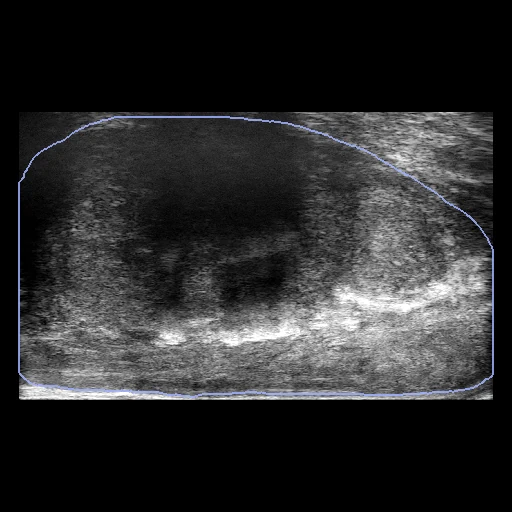
The first test caseClick to look at every case.
- Test cases
- 10 test patients drawn with seed 2026 among the provider's 20 test patients, and 10 development patients among its 55 training patients. One sweep a patient, so no patient is on both sides.
- Truth
- contours by experts the prostate capsule outlined on every frame of the stack by two non-expert annotators, each frame reviewed and edited by an expert urologist until all three agreed: the dataset's expert annotations
- Source
- zenodo.org/records/10475293
doi.org/10.1016/j.compmedimag.2024.102326
arxiv.org/abs/2305.19956
github.com/mirthAI/MicroSegNet
arxiv.org/abs/2303.02128 - Licence
- CC BY 4.0
10 cases for tuning, never tested
train_39, train_33, train_26, train_09, train_40, train_43, train_28, train_52, train_41, train_10