 fidopt
MR-ART (OpenNeuro ds004173), motion-corrupted T1w to still T1w
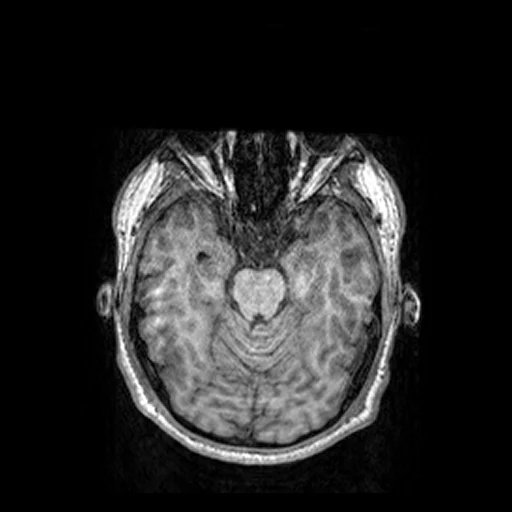
A motion-corrupted T1-weighted brain MRI (headmotion2) and a still T1-weighted scan of the same session, rigidly registered onto it by the corpus as the target (MR-ART, OpenNeuro ds004173).
Read before comparing (4)
- Target. The still MPRAGE, rigidly registered by the corpus onto the headmotion2 scan and resampled once with a cubic B-spline, negative overshoots set to zero; the source is as delivered. Separate acquisitions and an imperfect registration make it no exact voxelwise truth: graded automatic and ranked apart from provider-aligned targets.
- Mask. The head on the registered still scan, intersected with nonzero data in both scans, so defaced voxels and voxels outside the field are out. It depends on the target and is given to every method.
- Intensities. No physical calibration is assumed. truth.dynamic_range is 835, the median of the 99.9th percentiles inside the mask of the ten test targets drawn first (567 to 955; 834 over the 11), one range for the dataset's PSNR and SSIM, as in BraTS2021_Syn.
- Baseline. Inside the mask of the test cases a constant at the target's median is off by 77 to 124 on average, and the motion scan itself by 15 to 66: a method has to do better than its own input.
| Accuracy | Cost | ||||||||
|---|---|---|---|---|---|---|---|---|---|
| # | Method | MAE | Change | PSNR dB | SSIM | Time s | RAM GB | GPU GB | Images |
| 1 | SynthSRCPUapp | 108.8 ±20.7 | +73.3 | 15.18 ±1.40 | 0.462 ±0.041 | 10.5 | 0.5 | ||
| Source as given | 35.5 ±10.0 | 24.42 ±2.12 | 0.817 ±0.067 | ||||||
The order averages each method's ranks on MAE, PSNR dB, SSIM, so the first one is not always the best in every column. ± is the 95% interval of the mean over the 11 cases. Two neighbours are tied when a paired Wilcoxon test on the shared cases does not find the upper one better on MAE (5%): the places a method could hold are then shown under its own. The best value of each column is in colour. Click a row to see its images, a column title to sort by it. Time and memory measured on Laptop.
MAE: mean absolute error of a synthetic image against its target, inside the body, in the image's units. PSNR: the same by signal-to-noise ratio, higher is better. SSIM: the same by structural similarity, 1 is perfect.
Case by case
Click a score to look at that result: the target image, and over it the method's synthetic image. Underlined scores have their image; for the others you see the case without the result.
About the data
- Test cases
- 11 test subjects and 10 development subjects, drawn with seed 2026 from the 115 whose still scan the provider rates good and whose headmotion2 scan it rates medium or bad. prepare.py --pool rebuilds the list.
- Truth
- target image by a program the same-session still MPRAGE after the corpus rigid registration and B-spline resampling onto the headmotion2 scan, in scanner intensity units
- Source
- openneuro.org/datasets/ds004173/versions/1.0.2
doi.org/10.18112/openneuro.ds004173.v1.0.2
doi.org/10.1038/s41597-022-01694-8 - Licence
- CC0 1.0
10 cases for tuning, never tested
sub-630780, sub-764976, sub-460834, sub-337488, sub-988484, sub-938344, sub-253306, sub-089207, sub-848092, sub-282628