 fidopt
OpenOrganelle ground-truth crops
A block of a FIB-SEM volume of cultured cells or mouse or fly tissue, 2 to 8 nm a voxel, every voxel labelled by hand by Janelia's annotators, merged into twelve structures (OpenOrganelle).
10 test casescellimage EM
Read before comparing (8)
- Truth. A ground-truth crop is a region of a FIB-SEM volume in which a person labelled every voxel, made to train the networks that segment the whole volumes. The bucket names no annotator and no second reader, and gives no agreement between annotators.
- Pool. A crop is eligible with the bucket's 8-bit image, a level of the label map on the image's voxels, every class of the twelve structures annotated, at least three of them present and at most 2^26 voxels. Each volume gives the first of its eligible crops in the seeded order, of 184 in all.
- Specimens. One crop a volume keeps a specimen out of both test and development, but two volumes may still be two cells of one line or two pieces of one organ (jrc_hela-2 and jrc_hela-3; the three mouse liver volumes).
- Public. These are training crops of the CellMap Segmentation Challenge; none is one of its test crops. A network trained for the challenge or on OpenOrganelle's crops has seen the test cases: only a method trained elsewhere meets unseen images.
- Grid. Most crops were drawn at half the image's voxel size. A case takes the provider's own reduction of the labels to the image's voxels and the image at full resolution, except jrc_cos7-1a, jrc_cos7-1b and jrc_mus-liver, drawn on the image's voxels. The test crops hold 100 x 100 x 100 to 500 x 500 x 250 voxels.
- Labels. The corpus merges the provider's forty or so classes into twelve structures, an organelle's membrane and lumen together and the nuclear envelope with the nucleus. The cytosol, the ribosomes, the centrosome, glycogen and the other classes are background. The instance maps are not kept: one label a structure, no instance metric.
- Structures. A test crop holds 4 to 10 of the twelve: the mitochondria and the endoplasmic reticulum are in all ten test crops, the Golgi and the lipid droplets in one, the peroxisomes in none. The mean is over the structures each case holds, so the rare ones weigh on one or three cases only.
- Tolerance. Distances are in nanometres and the surface tolerance is 1 nm, under a voxel: the surface Dice asks for the truth's own outline. The truth grown by two voxels scores a Dice of 0.82 and a surface Dice of 0.24 over the test crops, thin structures losing most; the image's dark voxels named mitochondria score a Dice of 0.02.
No method has a result on every case of this dataset yet.
Case by case
Click a score to look at that result: the image, the truth in green and the method's map in red. Underlined scores have their image; for the others you see the case without the result.
About the data
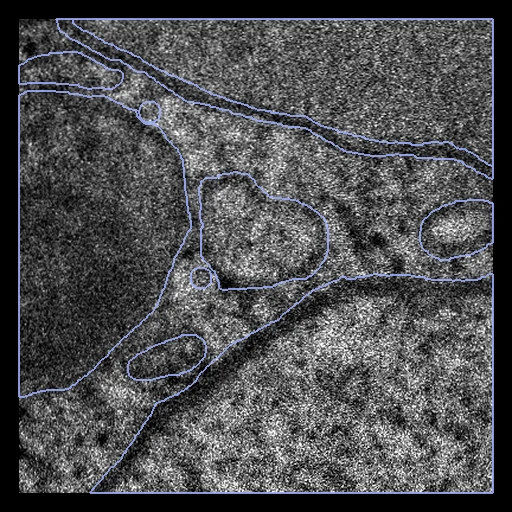
The first test caseClick to look at every case.
- Test cases
- 10 test crops drawn with seed 2026 among 17, one crop a volume, and the 7 others for development. 17 of the bucket's 29 volumes have an eligible crop: seven have no 8-bit image in the bucket and five others no eligible crop.
- Truth
- contours by experts every voxel of a crop labelled by hand with one class by Janelia's annotators; the corpus merges the classes into twelve structures, an organelle's membrane and lumen together, and leaves the cytosol and the other classes as background
- Source
- openorganelle.janelia.org
registry.opendata.aws/janelia-cosem
github.com/janelia-cosem/aws-opendata/blob/master/cosem-introduction.md
doi.org/10.1038/s41586-021-03977-3
cellmapchallenge.janelia.org
github.com/janelia-cellmap/cellmap-segmentation-challenge/blob/main/src/cellmap_segmentation_challenge/utils/classes.csv
github.com/janelia-cosem/fibsem-metadata/tree/stable/api - Licence
- CC BY 4.0 (the bucket's entry in the Registry of Open Data on AWS; Heinrich et al., Nature 2021, is the reference to cite)
7 cases for tuning, never tested
jrc_sum159-1_crop20, jrc_mus-nacc-1_crop115, jrc_fly-vnc-1_crop79, jrc_macrophage-2_crop39, jrc_mus-liver-zon-2_crop376, jrc_mus-liver_crop137, jrc_cos7-1b_crop291