 fidopt
OpenEar, temporal-bone CBCT segmentation
Registered CBCT of one post-mortem temporal-bone specimen from the OpenEar surgical simulation library, with thirteen structures delineated on the co-registered CBCT and micro-slicing images.
4 test caseshead and neckimage CBCT
Read before comparing (6)
- Images. GAMMA, DELTA, EPSILON, ZETA, ETA and THETA use the registered CBCT_Unembedded, the full specimen the temporal bone, sinus/dura and carotid annotations describe (source Table 1); ALPHA has no unembedded scan and uses CBCT_Alpha, after cutting and embedding. CBCT values and geometry are kept.
- Labels. The component masks are sampled by nearest neighbour onto the CBCT grid through their released headers, with no new registration; DELTA's masks have half the CBCT's voxel spacing. Twelve of the thirteen common structures are scored; ALPHA's RW and Duct components are not included.
- Truth. The small structures were drawn on the embedded CBCT and the micro-slicing images and reach the full-specimen CBCT through the provider's registration; preparation can shrink soft tissue and micro-slicing deform it. No in-vivo clinical accuracy claim follows, and the small sample and unknown donor linkage require a separate track.
- Ignored. ignore.nii.gz is taken out of truth and prediction before scoring: voxels two structures claim after grid conversion, the sinus_and_dura mask and every voxel outside the provider's segmentation box. It covers 18 to 50% of a grid, almost all air or background.
- Sinus and dura. Label 12 is a drawn volume that fills the empty space on the bone's cranial side and ends on flat faces, at the background's values: a method cannot find its outer faces from the image. At most 0.4% of a specimen's bone-dense voxels lie in it, so ignoring it costs almost nothing.
- Unlabelled bone. Bone inside the box that the provider left out of temporal_bone is still scored: 5.9% of the bone-dense voxels on EPSILON (test), 3.2% on DELTA and 5.3% on ZETA, 1.5% or less on the others. A method that labels all the bone is charged for it.
No method has a result on every case of this dataset yet.
Case by case
Click a score to look at that result: the image, the truth in green and the method's map in red. Underlined scores have their image; for the others you see the case without the result.
About the data
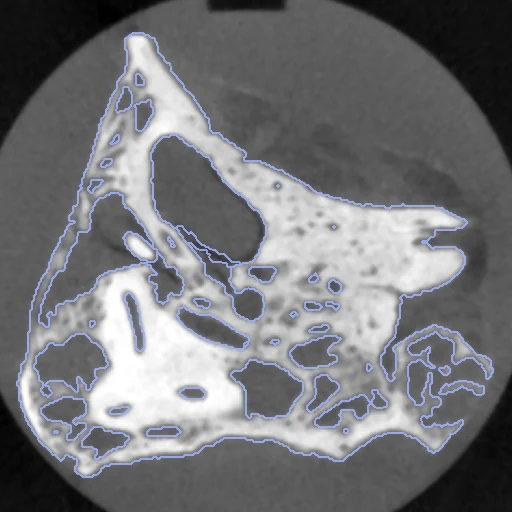
The first test caseClick to look at every case.
- Test cases
- Four test and three development specimens, drawn in seed-2026 order from the seven with a registered CBCT in the release; BETA has none and is left out. The paper reports four donors but the files do not give donor grouping, so this split does not establish donor independence.
- Truth
- contours by experts Threshold-supported manual segmentation in 3D Slicer using the registered CBCT and micro-slicing data. Names identify the component masks; their order differs between specimens. Twelve structures are scored; the provider's combined sinus/dura mask (12) is not (ignore map).
- Licence
- CC BY 4.0
3 cases for tuning, never tested
DELTA, ZETA, GAMMA