 fidopt
CT Lymph Nodes, abdomen
Contrast-enhanced CT of the chest, abdomen and pelvis of an NIH Clinical Center patient, with the marked lymph nodes of the abdomen and pelvis, most of them enlarged, traced by hand (CT Lymph Nodes).
10 test casesabdomenimage CT
Read before comparing (8)
- Truth. Masks traced by hand at the NIH Clinical Center, whose radiologists marked the nodes. The collection page names neither tracer nor tool, and Seff et al. (MICCAI 2015), cited for the masks, could not be read. Graded expert on the page's word: one tracing, no agreement between readers. TotalSegmentator has no lymph node class, so the outlines were checked by eye.
- Unmarked nodes. Only marked nodes are traced, 1 to 16 a scan on the test CTs. The marks measure 10.3 to 16.6 mm in short axis between quartiles (median 12.6 mm; 127 of 595 under 10 mm): mostly enlarged nodes. Nothing says every enlarged node was marked, and most nodes of normal size were not.
- Scoring. A node the tracers left counts as an error, right or not: the Dice measures agreement with the marked set, not detection, and favours a method trained on these masks. On the 25 twin scans, a perfect map of both copies' nodes scores a median Dice of 0.81 (0.06 to 1.00) against the abdominal mask. A method should give its other nodes under another name.
- Twins. The 25 scans held twice carry the mediastinal nodes on one copy and the abdominal nodes on the other; the collection does not say so. Each pair shares mask size, voxel size, origin, sex and age, and the pair read whole (ABD_LYMPH_086 and MED_LYMPH_090) the same voxels: 151 scans, not 176 patients. A patient scanned on two days could not be told apart.
- Images. The NIH wrote the DICOM files with ITK from anonymised volumes: the headers keep only sex and age. The scans run from the neck or shoulders to the pelvis or thighs, portal-venous by their look, most with oral contrast, kept in Hounsfield units on the patient's axes. The map built from the DICOM SEG equals the NIH's NIfTI mask voxel for voxel.
- Nodes. On the test CTs they hold 2.9 to 52.3 ml in 1 to 17 pieces, from under the diaphragm (ABD_LYMPH_008) along the aorta and iliac vessels to the groin (ABD_LYMPH_065, six inguinal nodes). Inside the labels the CT reads as soft tissue, a median of 33 to 112 HU, with no lung. All nodes share one label. The surface Dice is at 1 mm.
- Overlap. No other descriptor names the collection. None of the 40 scans built for the two CTLymphNodes sets shares a slice with the 20 fixed images of PancreasCT8, the corpus's other NIH Clinical Center CTs (38 pairs of equal pixel size, at most 23% of a slice's pixels equal); its resampled moving images could not be compared. MediastinalLymphNodesCT is another cohort, from Boston.
- Outside numbers. No segmentation challenge ran on these masks and the collection's papers report detection, so no outside Dice compares. The masks are public since December 2015 and widely used for training: a model may have seen the test cases.
No method has a result on every case of this dataset yet.
Case by case
Click a score to look at that result: the image, the truth in green and the method's map in red. Underlined scores have their image; for the others you see the case without the result.
About the data
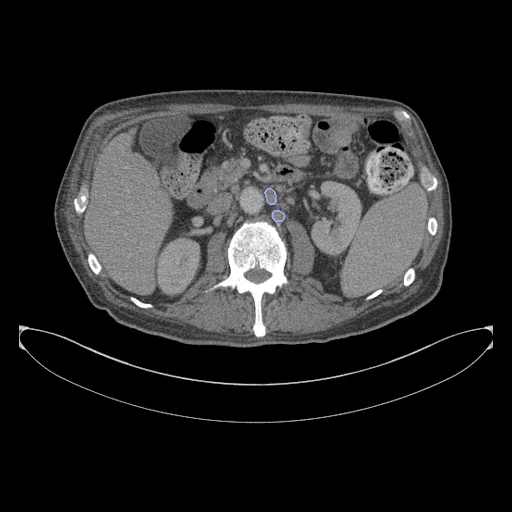
The first test caseClick to look at every case.
- Test cases
- 10 test CTs drawn with seed 2026 among the 51 pool patients outside development, and 10 development CTs, the last of the same seeded order. The pool is 61 of the collection's 86 ABD_LYMPH scans: the other 25 are also in the collection under a MED_LYMPH name (TWINS in ../CTLymphNodes_Mediastinum/prepare.py) and are cases of CTLymphNodes_Mediastinum only.
- Truth
- contours by experts the lymph nodes of the abdomen and pelvis, down to the groin, that were marked on the scan, most of them enlarged, traced by hand at the NIH Clinical Center, all in one label; the unmarked nodes there and every node of the chest are background
- Source
- www.cancerimagingarchive.net/collection/ct-lymph-nodes
doi.org/10.7937/K9/TCIA.2015.AQIIDCNM
www.cancerimagingarchive.net/wp-content/uploads/MED_ABD_LYMPH_MASKS.zip
www.cancerimagingarchive.net/wp-content/uploads/MED_ABD_LYMPH_ANNOTATIONS.zip
doi.org/10.1007/978-3-319-24571-3_7
doi.org/10.1007/978-3-319-10404-1_65
arxiv.org/abs/1406.2639 - Licence
- CC BY 3.0
10 cases for tuning, never tested
ABD_LYMPH_047, ABD_LYMPH_003, ABD_LYMPH_057, ABD_LYMPH_084, ABD_LYMPH_080, ABD_LYMPH_085, ABD_LYMPH_079, ABD_LYMPH_030, ABD_LYMPH_021, ABD_LYMPH_064